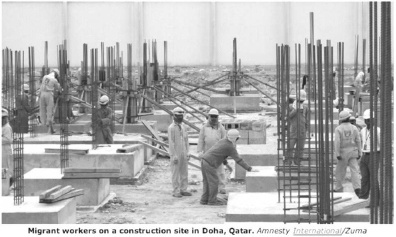
Bribery, corruption, and worker abuse have reached a boiling point in Qatar, the 2022 World cup host.
The world was shocked when Qatar won the bid to host the 2022 World Cup in 2010. Of course, there’s the weather: the Persian Gulf state suffers temperatures well north of 100 degrees – sometimes over 120 – in the World Cup months of June and July. And there’s the fact that the tiny, oil-rich nation has little soccer history or presence on the sport’s international stage: It’s never sent a team to the Cup to compete. Turns out, there may have been more suspicious factors behind FIFA’s bizarre decision. The British press have alleged that Qatari billionaire Mohamed bin Hammam paid off FIFA officials in order to secure their votes to bring the Cup to his country. If the allegations are true, FIFA Vice President Jim Boyce said he’d push to strip Qatar of the Cup and re-award it to another country. What could push all this to critical mass is ongoing outrage over Qatar’s mistreatment of the construction workers tasked with building Cup infrastructure. The long hours of hard labor in unbearably hot conditions have proven lethal: It’s estimated that 1200 workers have died in Qatar since the country was awarded the Cup. They are almost exclusively migrant workers from South and Southeast Asia and can only leave Qatar with the written permission of their employers – a system some watchers have compared to slavery. Five of the World Cup’s six top corporate sponsors (including Coca-Cola and Adidas) have voiced concern over corruption and worker abuse allegations, and publicly back formal investigations. Blatter, in a rare off-message moment, admitted that giving Qatar the bid was a “mistake”. Qatari officials have denied wrong doing on corruption charges and promised to reform labor laws – but clearly, they have a lot more to worry about than air-conditioning their stadiums.
(Adaptado de: <http://www.motherjones.com/media/2014/06/fifa-world-cup-scandals-brazil-qatar>. Acesso em: 17 set. 2014.)
Assinale a alternativa que apresenta, corretamente, o argumento central no qual se baseia o texto.