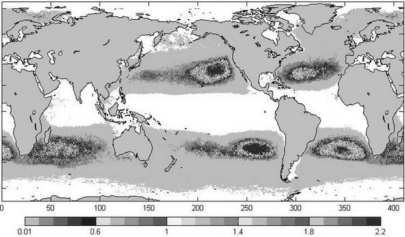
Before Malaysia Airlines Flight 370 went missing, sea trash was not a global headliner. However, as hundreds of objects sighted off the Australian coast as possible aircraft debris turn out to be discarded fishing equipment, cargo container parts, or plastic shopping bags, a new narrative is emerging in the hunt for the missing plane: There is more garbage out there than you think. Most of it is plastic. And marine life ingests it, with catastrophic consequences. Kathleen Dohan, a scientist at Earth and Space Research in Seattle, Washington, plotted the movement of debris in a time-lapse video that shows where objects dropped into the ocean will end up in ten years. The objects migrate to regions known as garbage patches. The Pacific and Atlantic Oceans have two patches each, north and south. The Indian Ocean’s garbage patch is centered roughly halfway between Africa and Australia. The term “patch” suggests this floating detritus is packed together in an oceanic version of a landfill. Instead, these “patches” are actually huge zones where debris accumulates but floats free, circulating continuously. So it’s possible for sailing ships and other small boats to inadvertently sail into a garbage patch region and encounter rubbish. About 90 percent of the debris in all five garbage patches is plastic, says Marcus Eriksen, a marine scientist and founder of the 5 Gyres Institute, which works to reduce pollution from disposable plastics. “This is relatively new if you think about plastic. Only since the 1950s have consumers used plastics. Now, a half-century later, we are seeing an abundant accumulation of microplastics from all single-use, throwaway plastics like bags, bottles, bottle caps, kitchen utensils. I have pulled cigarette lighters from hundreds of bird skeletons.”
(Adapted from: http://news.nationalgeographic.com/news/2014/04/140404-garbage-patch-indian-ocean-debris-malaysian-plane/ ?utmsource=Facebook&utmmedium=Social&utmcontent=linkfb20140407news−malpla&utmcampaign=Content. Accessed on: April 6th 2014.)
According to the text, consider the following statements about the objects on the ocean.
I. Australian coast guard recovered several objects from the Malaysian missing airplane.
II. Debris from the Flight 370 polluted a large portion of the ocean threatening the sea life.
III. Most of the objects found next to the Australian coast consisted of material dumped as waste.
IV. News about the ocean garbage patch hit the headlines because of the searches for the Flight 370.
Choose the correct alternative.