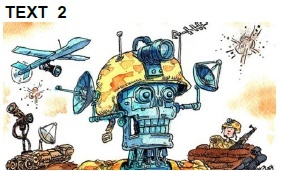
Chaos fills battlefields and disaster zones. Artificial intelligence may be better than the natural sort at coping with it
ARMIES have always been divided into officers and grunts. The officers give the orders. The grunts carry them out. But what if the grunts took over and tried to decide among themselves
on the best course of action? The limits of human psychology, battlefield communications and (cynics might suggest) the brainpower of the average grunt mean this probably would not work in an army of people. It might, though, work in an army of robots.
Handing battlefield decisions to the collective intelligence of robot soldiers sounds risky, but it is the essence of a research project called ALADDIN. Autonomous Learning Agents for Decentralised Data and Information Networks, to give its full name, is a five-year-old collaboration between BAE Systems, a British defence contractor, the universities of Bristol, Oxford and Southampton, and Imperial College, London. In it, the grunts act as agents, collecting and exchanging information. They then bargain with each other over the best course of action, make a decision and carry it out.
So far, ALADDIN's researchers have limited themselves to tests that simulate disasters such as earthquakes rather than warfare; saving life, then, rather than taking it. That may make the technology seem less sinister. But disasters are similar to battlefields in their degree of confusion and complexity, and in the consequent unreliability and incompleteness of the information available. What works for disaster relief should therefore also work for conflict. BAE Systems has said that it plans to use some of the results from ALADDIN to improve military logistics, communications and combat-management systems.
ALADDIN's agents ─ which might include fire alarms in burning buildings, devices carried by emergency services and drones flying over enemy territory ─ collect and process data using a range of algorithms that form the core of the project.
In the case of an earthquake, for instance, the agents bid among themselves to allocate ambulances. This may seem callous, but the bids are based on data about how ill the casualties are at different places. In essence, what is going on is a sophisticated form of triage designed to make best use of the ambulances available. No human egos get in the way. Instead, the groups operating the ambulances loan them to each other on the basis of the bids. The result does seem to be a better allocation of resources than people would make by themselves. In simulations run without the auction, some of the ambulances were left standing idle.
All of which is very life-affirming when ambulances are being sent to help earthquake victims. The real prize, though, is processing battlefield information. Some 7,000 unmanned aerial vehicles, from small hand-launched devices to big robotic aircraft fitted with laser-guided bombs, are now deployed in Iraq and Afghanistan. Their combined video output this year will be so great that it would take one person four decades to watch it.
Data are also streaming in from other sources: remote sensors operating as fixed sentries, sensors on ground vehicles and sensors on the equipment that soldiers carry around with them (some have cameras on their helmets). On top of this is all the information from radars, satellites, radios and the monitoring of communications. The result, as an American general has put it, is that the armed forces could soon be ―swimming in sensors and drowning in data‖.
ALADDIN, and systems like it, should help them keep afloat by automating some of the data analysis and the management of robots. Among BAE Systems' plans, for example, is the co-operative control of drones, which would allow a pilot in a jet to fly with a squadron of the robot aircraft on surveillance or combat missions.
And for those worried about machines taking over, more research will be carried out into what Dr Jennings calls flexible autonomy. This involves limiting the agents' new-found freedom by handing some decisions back to people. In a military setting this could mean passing pictures recognized as a convoy of moving vehicles to a person for confirmation before, say, calling down an airstrike.
Whether that is a good idea is at least open to question. Given the propensity for human error in such circumstances, mechanized grunts might make such calls better than flesh-and-blood officers. The day of the people's — or, rather, the robots '— army, then, may soon be at hand.
Disponível em: <www.economist.com>.
In this context, the word ―grunt‖ was used to mean