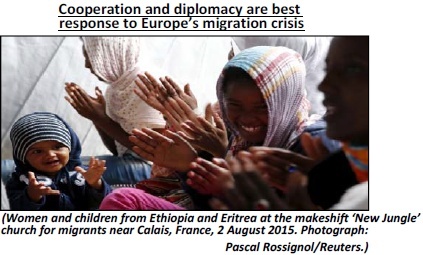
I was puzzled as to why Patrick Kingsley’s compassionate article exploring the reasons thousands of refugees are fleeing Eritrea for Europe chose to argue that the country is not at war. Of course it is. There is a big difference between a failed and frozen peace process and the resolution of an armed conflict. The longstanding border conflict with Ethiopia cannot justify the well‐documented human rights abuses committed by President Isaias Afwerki’s government, but it is more of a driving cause of this crisis than holes in a British fence. The two states are locked in a costly border war, and their citizens are suffering the consequences. Powerful governments such as the US and the UK appear to have given up on finding a negotiated solution. Even the UN security council seems unable to uphold its own decisions on the boundary dispute calling for Ethiopian withdrawal. We neglect the agendas of conflict resolution and human rights at our peril. The UK, EU and the UN should renew their full spectrum of diplomatic efforts to help Ethiopia and Eritrea resolve their border war. It remains the engine room of so much human suffering and arrested development. The resolution of these multiple problems cannot be found in policies of coercion and isolation alone. To help prevent the deaths of future asylum seekers, we need to commit to the long‐term, multilateral and difficult paths of engagement and dialogue.
(Andy Carl. Available: http://www.theguardian.com/world/2015/aug/04/. Adapted.)
In “the US … on finding a negotiated solution.” (line 06) the pattern of gerund use is the same as in: