Sleeping on stilts in the Amazon
As 75-year-old villager Antônio Gomes told us
stories of growing up in Boca do Mamirauá, a tiny
settlement in the northern Amazon rainforest, I tried to
ignore the tiny blue flies biting through my trousers.
Despite my interest in hearing how locals survive in this
remote part of the Brazilian rainforest, now a part of the
Mamirauá Sustainable Development Reserve, I was
grateful to escape when he finished, finding refuge in
one of the tall wooden houses.
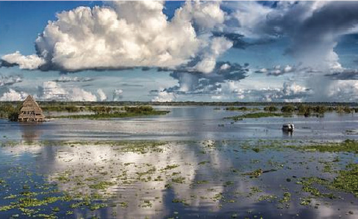
(When the Amazon floods, all of its residents – both animals and people – have to adopt an amphibious lifestyle. Kim Schandorff/Getty)
The houses hover some 3m above the ground. They are not unusual: almost everything in the
Mamirauá reserve is on stilts, even the chicken coop. It has to be. Although much of Brazil is currently
suffering one of the worst droughts in decades, this part of the Amazon is almost completely flooded for the
six-month wet season. By April, the end of the rainy season, the river rises up to 10m high and overflows its
banks. As a result, all living things in the forest, including locals, must adopt an amphibious lifestyle. Even
the jaguars have learned to adapt by living in tree branches when the floods arrive.
Only 1,000 tourists per year are allowed to visit Mamirauá, which, at 57,000sqkm, is the largest
wildlife reserve in the country. Created in 1984 to save the once-endangered uakari monkey, the reserve is
the most carefully managed and protected part of the Amazon – and is also home to what many consider
Brazil’s most successful sustainable tourist resort, the Uakari Floating Lodge. “If [the reserve] had not been
created,” guide Francisco Nogeuira said, “the rivers and lakes would be empty of fish, and who knows how
many trees would remain today?”
(Disponível em: http://www.bbc.com/travel/feature/20140626-sleeping-on-stilts-in-the-amazon)
In the last paragraph, it is possible to find sentences in