Increase in diabetes brings a spike in
related eye disease
Blood vessels can leak into the retina
By Nanci Hellmich
USA Today
The nation‟s rising level of diabetes is driving another health problem: a significant jump in adults with vision problems from a related condition called diabetic retinopathy.
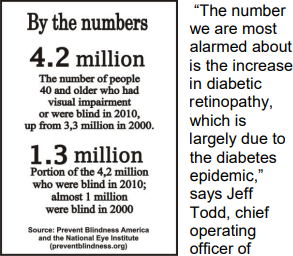
From 2000 and 2010, there was an 89% increase in the number of people with diabetic retinopathy, which affects the tiny blood vessels of the retina. The most severe forms can impair vision if not treated. About 7.7 million people ages 40 and older have diabetic retinopathy, the new estimates say.
The numbers emerge from an analysis, out today, by a group of researchers and sponsored by Prevent Blindness America and the National Eye Institute.
Prevent Blindness America.
Almost 26 million people in the USA have
diabetes, the Centers for Disease Control
and Prevention says. In diabetic
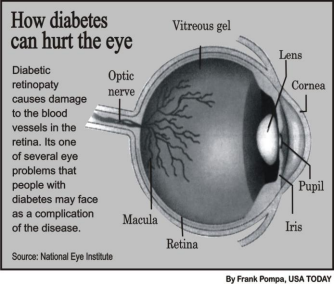
retinopathy, high blood sugar causes
small blood vessels to swell and leak into
the retina, blurring vision and sometimes
leading to blindness. A government study
in 2008 found that about 4.2 million adults
had the disease, the leading cause of
blindness in adults.
“You can treat and stop progression,”
says Beatriz Muñoz, an associate
professor of ophthalmology at the Wilmer
Eye Institute at Johns Hopkins School of
Medicine in Baltimore. But the disease
can be “asymptomatic,” or without
symptoms: “You may not know you have
it,” she says, “So it‟s important to have
regular eye exams.”
The vision analysis found that overall, the
number of people over 40 with vision
impairment and blindness has increased
23% in the past decade, partly because
of more people with eye conditions such
as cataracts.
Vision impairment is defined as having
worse than 20/40 vision in the better eye
even with glasses. In the USA, people are
typically considered blind with vision of
20/200 or worse in their best eye.
If the trend remains the same, about 13
million in the USA will have visual
impairment or be blind by 2050, the report
says. “The increase we‟re seeing in eye
diseases mirrors the increase in the aging
population,” Todd says.
Estimates for eye conditions:
• 24.3 million people 40 and older have
cataracts, a 19% jump from 2000. A
cataract is a clouding of the eye‟s
clear lens that appears with age.
Surgery is effective in restoring
vision. Muñoz says, but “there is no
clear way to prevent it.”
• 2.7 million people ages 40 and older
have open−∠ glaucoma, the most
common form of the disease, up
22%. Glaucoma causes damage to
the optic nerve. Treatments can slow
progression, she says.
• 2.1 million people ages 50 and older
have late age-related macular
degeneration, a 25% increase from
2000. Late AMD is the most severe
form, and treatments can slow
progression and prevent vision loss
for some of the forms, Muñoz says.
USA Today, Wednesday, June 20, 2012, p. 6D.
The increase in diabetic retinopathy was of 89%