INSTRUÇÃO: Leia o texto que segue para responder à questão.
How cinema stigmatises mental illness
That depictions of “madness” have been dominated by horror films is revealing of the film industry’s historic insensitivity about mental health, writes Arwa Haider.
You don’t have to be ‘mad’ to be in the movies – but the film industry has generally shown a shaky vision
of mental health. It’s not that cinema evades ‘taboo’ themes here; it’s more that it tends to swing wildly
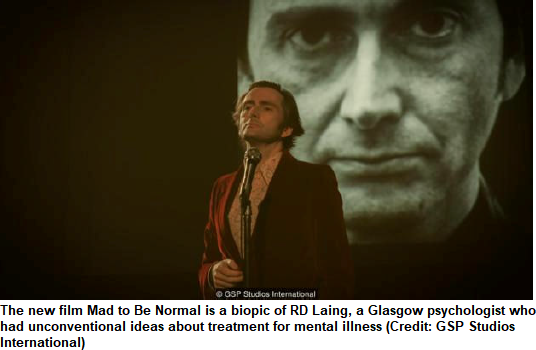
from sentimentality to sensationalism. Which means that the perspective of Mad to Be Normal, a 1960s-set
biopic of Scottish psychiatrist RD Laing, just out on video on demand (VoD), feels intriguingly new. David
[5] Tennant stars as Laing: a complex and charismatic figure, who earned fame for his radical, empathetic
treatment of mental illness.
The real-life Laing was sharply quotable (he described insanity as “a perfectly rational adjustment to an
insane world”) and counter-cultural (he argued that traditional society was “driving our children mad”; he
recommended LSD for his adult patients). He also fought personal demons including alcoholism and
[10] depression. Tennant’s onscreen Laing is impressively joined by Elisabeth Moss, Gabriel Byrne and Michael
Gambon. Still, mainstream cinema struggles with a mental health ‘hero; Mad to Be Normal’s trailer booms:
“To some he’s certifiable… To others he’s a saint”.
Meanwhile on the small screen, there’s a feverish buzz around the imminent Netflix series Maniac (based
on the Norwegian psych ward-set drama of the same name). In the glossy and trippy US show, Emma Stone
[15] and Jonah Hill star as strangers undergoing a mysterious drug trial that claims to resolve mental health
issues; “It’s not therapy – it’s science,” Maniac’s eerie Dr. Mantleray (Justin Theroux) tells his patients.
Stone explained to
Elle magazine:
“The thing I liked about Maniac was that it’s about people who have their own internal struggles and are
trying to fix them with a pill. But you see over the course of the show that human connection and love is
[20] really the only thing that gets us through life.”
So creative drama is drawn to the complexity and fragility of the mind – but mainstream entertainment still
demands a snappy fix. And the definition of ‘insanity’ is inherently problematic; it’s regarded as an
outmoded medical term. Dr. Ryan Howes writes in ‘Psychology Today’ that “it’s informed by medical
health professionals, but the term today is primarily legal, not psychological” and cites the Law.com
[25] definition: “mental illness of such a severe nature that a person cannot distinguish fantasy from reality,
cannot conduct her/his affairs due to psychosis, or is subject to uncontrollable impulsive behaviour.”
Yet our mainstream perceptions of ‘madness’ are still fixated with movie scenes – much more emphatically,
in fact, than the novels or memoirs on which they might be based. A classic film like One Flew Over the
Cuckoo’s Nest (1975) seals the impression of a soul-destroying psychiatric asylum, where livewire convict
[30] RP McMurphy (Jack Nicholson) feigns insanity to escape prison labour – yet is ultimately crushed by the
system. The dramatic depiction of patient treatment, particularly its brutal electroconvulsive therapy
sequences, had far-reaching impact. In 2011, The Telegraph went so far as to say that the film was
responsible for “irreparably tarnishing the image of ECT… It also catalysed the development of more
effective anti-psychotic drugs that allowed patients to… live , more normal lives.” [...]
Fonte: HAIDER, Arwa. How cinema stigmatises mental illness. Disponível em: http://www.bbc.com/culture/story/20180828-how-cinema-stigmatises-mental-illness. Acesso em: 17 set. 2018
No trecho “‘The thing I liked about Maniac was that it’s about people who have their own internal struggles and are trying to fix them with a pill.’” (linhas 18-19), podemos encontrar os seguintes tempos verbais destacados: