Leia o texto e responda a pergunta.
[1] SMASHING THE CUBICLES
[2] By designing new spaces around tablets, smart phones, and social technologies, companies can operate with far
[3] fewer desks.
[4] The quick expansion of social and mobile
[5] technologies is creating a widely distributed
[6] workforce. To better suit employees who come into
[7] offices more sporadically, some companies and
[8] design firms are testing radically new and more
[9] efficient configurations for physical offices, betting
[10] that improved technology will make the experiment
[11] more successful than similar ones in the 1990s.
[12] A project at the headquarters of Cisco Systems in
[13] San Jose, California, for example, overthrows
[14] decades-old conventions about office space.
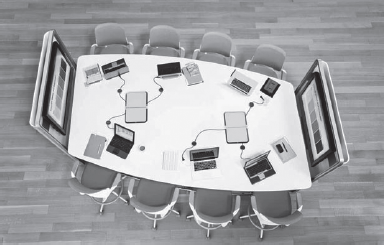
[15] Called Connected Workplace, it replaces
[16] individual cubicles with open clusters of wheeled
[17] desks that belong to groups, not individuals; personal belongings are largely confined to lockers.
[18] There are no PCs at the desks, because employees use mobile technologies. Rick Hutley, a Cisco vice president,
[19] chooses his desk according to which colleagues are present and what’s on the day’s agenda. Then he docks his
[20] tablet to a desktop port that includes a phone handset. The tablet handles voice and video calls whether it’s docked
[21] or mobile, and it can be used to share documents at meetings.
[22] It can also be plugged into a monitor and keyboard to be used like a full PC. “You can walk around with your entire
[23] world with you in this device,” Hutley says. “My laptop would often stay on my desk, but the tablet never does.” If he
[24] needs to make a private voice or video call, he can step into one of the rooms at the edges of the cluster.
[25] Cisco’s vision is an example of a broader effort to reshape office technologies and environments. “We used to have
[26] boring stuff at work and more interesting technology at home,” says Prith Banerjee, leader of Hewlett-Packard’s
[27] research arm. “Now office technology will make use of the same cool experiences and interfaces.”
[28] Such changes could save a lot of money. Cisco’s project, for example, was launched after an internal study found
[29] that cubicles were vacant two-thirds of the time while people roamed the campus or worked remotely. Company
[30] calculations show that the building used for the project can accommodate 140 employees, up from 88 in designs
[31] used in traditional Cisco buildings, and that real-estate costs should drop by 37 percent.
[32] Over the long term, Cisco hopes to save on health costs, too, because people who move around more frequently are
[33] less likely to suffer health problems. The company is planning to study whether the more mature technology of today
[34] can conquer resistance that hobbled previous attempts to build offices with little private space.
[35] By Tom Simonite / Massachusetts, Technology Review, MIT, September/October 2011
[36] Adapted from http://www.technologyreview.com/business/38407/?p1=Magstory1
Na sentença “My laptop would often stay on my desk, but the tablet never does.” (linha 23), “but the tablet never does” quer dizer