Leia o texto para responder à questão
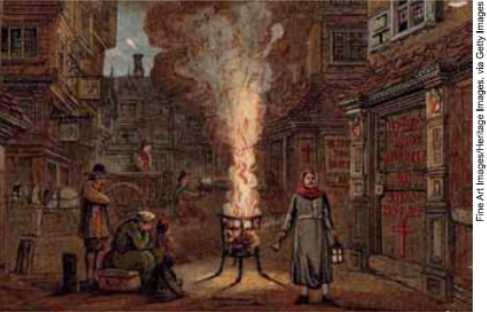
“Bring Out Your Dead,” an illustration of a street during the Great Plague
in London, 1665, with a death cart and moumers.
The city that gave us the word quarantine nearly 600 years ago is once again facing an epidemic. On Feb. 23, officials in Venice canceled the final days of its Carnival. The coronavirus COVID-19 had arrived. Faced with a novel virus, it’s worth reconsidering Italy’s long experiences with epidemics and considering the lessons. Though the etiologies of plague and the present coronavirus differ hugely, the social consequences of these outbreaks resonate in alarmingly similar ways.
The past offers clear lessons about human responses to outbreaks of infectious disease. In the Renaissance, Italy was made up of small territorial states, and travel between them was regularly restricted because of outbreaks of plague.
In the opening to The Decameron, the poet Giovanni Boccaccio described reactions in his native Florence to an outbreak. He lamented that “the authority of the laws, both human and divine, was dissolved and fallen into decay.” We should take Boccaccio’s account as a warning.
Italy only became a single nation in 1861; its deep regional divisions are still felt politically, linguistically and gastronomically. In this time of coronavirus, Italy’s national identity is showing signs of strain. In addition to closing off certain towns with clusters of infections, regional governments are working to isolate themselves from the rest of the country. These measures are about much more than health controls. They highlight regional identities and emphasize the tensions between local and national actions being taken to contain Italy’s outbreak.
We should be on guard against the ways that outbreaks of disease have historically led to the persecutions of marginalized people. In Italy, anti-migrant sentiment is also being combined with anxieties about the new coronavirus. The Italian interior ministry announced that 276 migrants who were rescued off the coast of Libya would be placed in mandatory quarantine in Sicily, though they had no connection to locations affected by the coronavirus. This kind of slippage from disease to xenophobia is an outcome that we have seen throughout history. It represents the breakdown of our society’s laws and morals in the face of fear. It, too, is a symptom of disease.
(Hannah Marcus. www.nytimes.com, 01.03.2020. Adaptado.)
No trecho do primeiro parágrafo “Though the etiologies of plague and the present coronavirus differ hugely”, o termo sublinhado expressa ideia de