Leia os textos I, II e III para responder as QUESTÃO.
TEXTO I
How migration is a gender equality issue
Women migrate for diverse reasons: from leaving behind poverty, conflict and climate-related disasters to escaping deeply entrenched gender inequalities, including sexual and gender-based violence and lack of access to livelihoods and resources.
Many women migrate in pursuit of work or educational opportunities and the possibility of a better life for themselves and their families.
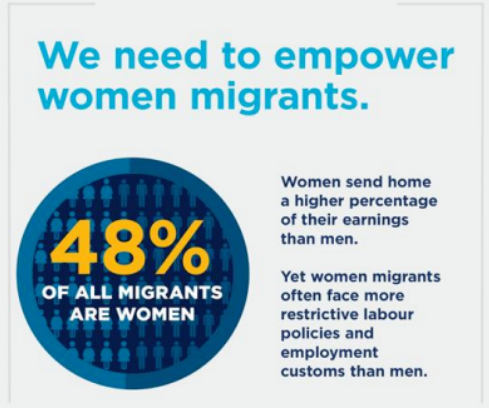
Comprising roughly half of the world’s 272 million migrants, migrant women are agents of change and leaders who contribute to their countries of origin, transit and destination economically and socially in multiple ways. They bring diverse talent and expertise and send financial remittances to their families and communities, allowing economies to thrive.
In what is called “social” remittances, they reshape norms, ideas and behaviours through the social and cultural capital they carry. And as doctors, nurses, scientists, researchers, entrepreneurs, essential workers and more, they are the backbone of the COVID-19 response.
Despite their valuable contributions, migrants face pervasive, intersecting forms of discrimination that impact their well-being and safety at all stages of the journey. Migration is a gendered process and impacts women and men differently: It is entrenched in a globalized sexual division of labour in which there is a demand for women migrant workers in specific service sectors, such as domestic and care work.
Gender stereotypes limit women’s autonomy and decision-making processes, increasing their vulnerability to the systematic violation of their human rights.
Yet, neither a gender-based approach not the specific experiences relating to migrant women are usually captured in migration laws and policies. Collecting and analyzing sexdisaggregated data is a critical step in developing effective gender-responsive polices, programmes and laws that address migration’s unique impacts on women and girls. Doing so is a human rights imperative: When done right, it would ensure safe migration and ultimately prevent labour and humans rights violations, save lives, promote greater gender equality and enhance the well-being of individuals, families and communities.
Disponível em:https://interactive.unwomen.org/multimedia/explainer/migration/en /index.html#:~:text=Migration%20is%20a%20gendered%20process,as%20domes tic%20and%20care%20work
TEXTO II
Disponível em: https://rafugeesmigrants un .org/infographics
TEXTO III
During the COVID-19 pandemic, women migrant workers around the world have been on the front lines, working in essential but low-paid and vulnerable jobs – including as health and care workers, nurses, cleaners and agricultural workers – where they face a high risk of exposure to COVID-19.
Travel restrictions and border closures have made cross-border travel more complex and difficult.
Migrant women seeking to return to their countries of origin may decide against travelling for fear of being denied reentry into the countries where they work. The health and economic fallout from the intersecting forms of discrimination, pervasive inequalities, racism and xenophobia further jeopardizing their livelihoods and well-being. Women migrant workers are reported to be losing their jobs in large numbers in some sectors. It is estimated that 75 per cent of migrant women work in the informal economy, often without a contract and with limited coverage by labour laws. Owing to the precarity of informal work, employers can more readily dismiss migrant women in response to the economic decline catalysed by the pandemic.
Disponível em: https://interactive.unwomen.org/multimedia/explainer/migration/e n/index.html
Os textos apresentados referem-se a pesquisas desenvolvidas pela ONU Mulheres, uma entidade das Nações Unidas que visa promover o empoderamento da mulher e igualdade de gênero.
Considere as proposições a seguir:
I. Durante a pandemia de COVID-19 houve um aumento significativo em 75% de migração de mulheres.
II. Durante a pandemia de COVID-19 houve um aumento significativo na contratação de mulheres migrantes para a realização de serviços essenciais.
III. Durante a pandemia de COVID-19 houve um aumento significativo em 48% de empoderamento das mulheres migrantes.
IV. Durante a pandemia de COVID-19 houve um aumento significativo na autonomia de decisão das mulheres migrantes.
Com base na análise, julgue as alternativas: