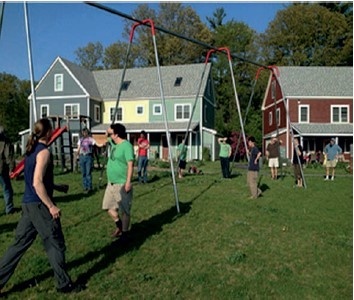
Living in Cohousing
Cohousing residents like to describe their communities as “intentional neighborhoods.” The underlying desire is to have a strong sense of community with your neighbors.
Who are your neighbors?
The majority of cohousing communities in the United States comprise 20 to 40 units, with other rangin from 7 to 67 homes. Cohousing attracts a wide range of household types: single people of all ages; couples; families and single parents of infants, toddlers, and school-aged children; couples whose children are grown; and retirees. Some cohousing communities create a shared vision or ethic, but residents typically represent a variety of religious and spiritual backgrounds. Cohousing residents often want to make a difference, which can become a stated mission. Many cohousing community websites demonstrate their commitment to improving the community and the world. Forb example, at Sunward Cohousing near Ann Arbor, MI, the goal is to create a place “where lives are simplified, the Earth is respected, diversity is welcomed, children play together in safety, and living in community with neighbors comes naturally.” Sonora Cohousing in Tucson, AZ, seeks “a diversity of backgrounds, ages and opinions, with our one shared value being the commitment to working out our problems and finding consensus solutions that satisfy all members.” Tierra Nueva Cohousing in Oceano, CA, ∃ “because each of us desires a greater sense of community, as well as strong interaction with and support from our neighbors.”
Is there a participation requirement?
Participation ebbs and flows among individual members as their personal lives allow them to contribute more time or less time to the community. There needs to be a mutual trust among members that everyone is doing what they can at any given time. A minimum level of participation generally includes cleaning the common house or maintaining the commonly owned grounds. Participation is dependent upon the community’s needs.
What about conflict?
Conflict happens. One of cohousing’s greatest strengths is the assumption that members can work out their disagreements. Most cohousing communities use consensus decision-making, which tends to satisfy most residents and give them a sense of participation on challenging issues. Some communities convene a conflict-resolution team when a particularly hot issue arises. Because many cohousing residents are seeking a collaborative and cooperative environment, disagreements are often worked out to the satisfaction of all involved. Cohousing residents share the common goal of making their lives more enjoyable by cooperating with their neighbors.
http://www.cohousing.org/living. Adaptado. Acesso em: 27/07/15
“…share the common goal…” (in the last paragraph), in Portuguese means