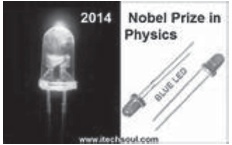
No dia 7 de outubro, os doutores Isamu Akasaki, Hiroshi Amano e Shuji Nakamura foram agraciados com o Prêmio Nobel de Física por terem criado um diodo emissor de luz LED.
New light to illuminate the world
7 October 2014
This year’s Nobel Laureates are rewarded for
having invented a new energy-efficient and
environmentfriendly
light
[5] source – the
blue lighte
m i t t i n g
diode (LED).
In the spirit of
[10] Alfred Nobel
the Prize rewards an invention of greatest benefit
to mankind; using blue LEDs, white light can be
created in a new way. With the advent of LED
lamps we now have more long-lasting and more
[15] efficient alternatives to older light sources.
When Isamu Akasaki, Hiroshi Amano and Shuji
Nakamura produced bright blue light beams from
their semi-conductors in the early 1990s, they
triggered a fundamental transformation of lighting
[20] technology. Red and green diodes had been
around for a long time but without blue light, white
lamps could not be created. Despite considerable
efforts, both in the scientific community and in
industry, the blue LED had remained a challenge
[25] for three decades.
They succeeded where everyone else had
failed. Akasaki worked together with Amano at
the University of Nagoya, while Nakamura was
employed at Nichia Chemicals, a small company
[30] in Tokushima. Their inventions were revolutionary.
Incandescent light bulbs lit the 20th century; the
21st century will be lit by LED lamps.
White LED lamps emit a bright white light, are
long-lasting and energy-efficient. They are
[35] constantly improved, getting more efficient with
higher luminous flux (measured in lumen) per unit
electrical input power (measured in watt). The
most recent record is just over 300 lm/W, which
can be compared to 16 for regular light bulbs and
[40] close to 70 for fluorescent lamps. As about one
fourth of world electricity consumption is used for
lighting purposes, the LEDs contribute to saving
the Earth’s resources. Materials consumption
is also diminished as LEDs last up to 100,000
[45] hours, compared to 1,000 for incandescent bulbs
and 10,000 hours for fluorescent lights.
The LED lamp holds great promise for increasing
the quality of life for over 1.5 billion people around
the world who lack access to electricity grids: due
[50] to low power requirements it can be powered by
cheap local solar power.
The invention of the blue LED is just twenty years
old, but it has already contributed to create white
light in an entirely new manner to the benefit of
[55] us all.
Disponível em: http://www.nobelprize.org/nobelprizes/physics/laureates/2014/press.html
Qual das alternativas abaixo melhor traduz o tempo verbal do trecho do texto sublinhado abaixo:
“ …but it has already contributed to create white light in an entirely new manner to the benefit of us all”.