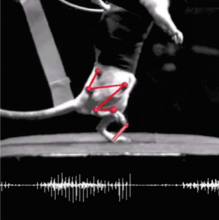
Paralyzed Rats Take 1,000 Steps,
Orchestrated by Computer
Controlled by software, paralyzed rats walk and
climb stairs.
[5] It’s a strange sight: a paralyzed rat walking on its
hind legs in a precise cadence, all controlled by a
computer.
“It is a little bit Frankenstein,” says Gregoire
Courtine, a neuroscientist at the École
[10] Polytechnique Fédérale in Lausanne, Switzerland,
who in a paper published yesterday in Science
Translational Medicine describes his efforts to use
electronics to restore fluid, realistic movements to
paralyzed animals.
[15] The study is part of a wider effort to help paralyzed
people walk again by zapping their spinal cords
with electrical pulses. These signals can replace
commands normally sent out by the brain, but which
are interrupted when the spinal cord is injured.
[20] This spring, doctors and researchers from the
University of Louisville and the University of
California, Los Angeles, said four men who had
been paralyzed for years were able to regain
movement in their legs, hips, ankles, and toes, and
[25] even stand using an implanted device that
stimulated their spinal cords, a technique called
epidural stimulation. Though the movements
achieved were modest—and fall short of allowing
the men to walk on their own—the technology let
[30] them exercise their legs, which seemed to restore
some movement.
His team hopes to test its ideas in a human volunteer
next year. “The idea is to use this in the
rehabilitation room,” Courtine says, citing evidence
[35] that exercising the spinal cord and legs may partly
restore severed connections to the brain.
Epidural stimulation technology is still a long way
from allowing paralyzed people to walk on their
own, though. Hunter Peckham, a bioengineer at
[40] Case Western Reserve University, says that patients
want to control their own movements, which means
that future versions of these systems must strike a
balance between automated routines and
movements picked by the user.
[45] Courtine says his group is working on developing
a brain-machine interface, such as electrodes
implanted in the motor cortex of the brain to record
intended movements, that might eventually allow
patients to control a spinal stimulator, and the
[50] movement of their legs, using their own thoughts.
By Courtney Humphries, Technology Review published by MIT, September 25, 2014
Adapted from http://www.technologyreview.com/news/ 531051/paralyzed-rats-take-1000-steps-orchestrated-bycomputer/
De acordo com o texto, o objetivo mais amplo do estudo de Courtine é