Text for question.
Music Festivals: a Massive Business
in the 50 Years Since Woodstock
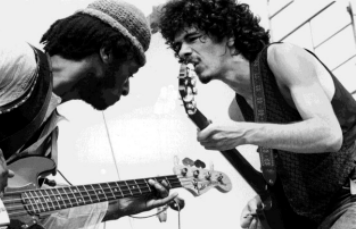
Carios Santana (right) and bessist David Brown perform with the
group Santana at the Woodstock Music Festival. Tucker Ransor
Hutton Archive/Getty Images. Acesso em: 25/07/2021
AUGUST 14, 2019.
Within the last decade, music festivals have grown into a major moneymaker in a competitive industry that sees hundreds of such events each year in the U.S. There are the big ones – Coachella, Lollapalooza, Outside Lands, Governors Ball – with big-ticket prices, multiple stages, camping options and nearly endless lists of performers. And alongside their rise in popularity, hundreds of smaller, niche or genre-specific festivals have flourished. Look up “music festival near me,” and you‟re likely to find one within at least a few hours‟ drive.
The origins of music festivals date back to ancient Greece, where such events often involved competitions in music, arts and sports. Modern music festivals in the U.S. grew out of the establishment and ethos of Woodstock. Though it was not the first event of its kind (the Newport Folk and Jazz Festivals, Milwaukee‟s Summerfest and the Monterey Pop Festival predate Woodstock), the 1969 event holds a mythical place within American pop-cultural history. Festivals have since evolved from the DIY, communal spirit of Woodstock, growing into mainstream businesses that reap profits and embrace corporate sponsorships, as more than 32 million people attend them each year, according to Billboard. Coachella, one of the most popular festivals in the country, grossed 114.6millionin2017,settingamajorrecordforthefirstrecurringfestivalfranchisetoearnmorethan100 million.
“They used to be more of a communion of culture,” says Carlos Chirinos, a professor of clinical music and global health at New York University. “A group of people who were into the same type of music, they would come together. That was the driving force throughout the 1970s and 1980s until it became a profitable format.” [...]
For artists, appearing at music festivals is an easier way to make money than depending on record sales or long tours, says Rishi Bahl, a musician and marketing professor at La Roche College in Pittsburgh, Pa. As record sales saw a steep decline in the early-to mid-2000s thanks to the growth of digital music, artists began depending on touring to earn money. Bahl says festival organizers quickly caught on to the spike in artists taking to the road and decided to pay them more to appear at their events. He notes that the majority of the touring schedule for a band like the Offspring, which played Woodstock ‟99, now consists of festival performances. Of the 20 shows the Offspring is playing the remainder of this year, about 15 are at music festivals. [...]
Disponível em: https://time.com/5651255/business-of-music-festivals/. Por Mahita Gajanan. Acesso em: jul. 2021. Texto adaptado.
De acordo com o texto, é CORRETO afirmar que