TEXTO:
Australia debates nuclear waste
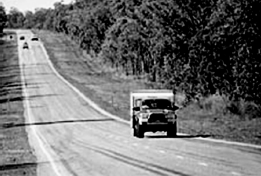
The Stuart Highway runs through Tennant Creek in Australia’s Northern Territory
Aboriginal groups are to debate controversial plans
to build Australia’s first nuclear waste dump on tribal
land in the Northern Territory.
The federal government has identified a remote
[5] cattle station north of Tennant Creek as a likely site.
In the next six years nuclear waste that Australia
sent to Europe for reprocessing will be returned but
officials in Canberra have yet to decide where to put it.
Muckaty Station, an isolated property 120
[10] kilometers from Tennant Creek in the Northern Territory,
has been chosen as a possible site. Local aborigines
have offered to sell the land for $11,000,000, a move that
has infuriated other indigenous groups in the area, who
worry about the health and environmental implications.
[15] These conflicting views are expected to collide at
a public meeting that will be held in Tennant Creek, an
old gold-mining town south of Darwin. Australian Greens
Senator Scott Ludlam says the plan to build a radioactive
waste dump in the region has become extremely divisive.
[20] Australia’s federal government said that Muckaty
Station would be subject to thorough scientific and
environmental assessments. Ministers have indicated
that the nuclear dump won’t be built if landowners oppose
it.
[25] Critics believe that recent earthquakes in that part
of the Northern Territory have raised questions about the
safety of the sites. The Australian Greens have said that
radioactive waste should be stored at the country’s only
nuclear facility on the outskirts of Sydney.
MERCER, Phil. Australia debates nuclear waste. Disponível em: <www.bbc.co.uk/worldservice/learningenglish/language/wordsinthenews/2010/03/100303witnaborigine.shtml>. Acesso em: 30 set. 2010.
Fill in the parentheses with T (True) or F (False).
( ) The verb form “are to debate” (l. 1) refers to future time.
( ) The relative pronoun “who” (l. 13) refers to “other indigenous groups” (l. 13).
( ) The word “These” (l. 15) is in the singular form.
( ) The modal “should” (l. 28) expresses prohibition.
Considering language use in the text, the correct sequence, from top to bottom, is