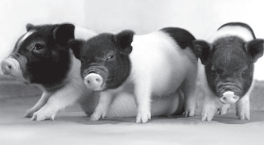
TEXTO:
Harvesting organs from animals may provide the
solution to the shortfall of human donors. However, two
technical obstacles need to be overcome before
animal-human transplants can become a medical
[5] reality. One is that human immune systems often reject
foreign tissue. The second problem comes from the
risk of disease transfer.
According to George Church of Harvard Medical
School, genetically engineering pigs may provide the
[10] key to overcoming this second problem. Due to their
size, pigs are natural candidates for animal-human
transplants, but their DNA is naturally rife with
dangerous PERVs, or porcine endogenous
retroviruses. An innovative gene-editing technique
[15] known as CRISPER has the capacity to identify and
delete specific sequences out of the genome. Upon
discovering that a single porcine gene enables PERVs
to infect human hosts, Dr. Church and his colleagues
turned CRISPER against the culprit. Initial results
[20] suggest that this procedure may be a success,
preventing human infection without compromising the
pig cells.
HARVESTING. Disponível em: <www.newsweek.com/end-humanorgan-shortages-and-other-science-breakthroughs-386132>. Acesso em: 13 maio 2018. Adaptado
Considering the possibility of using pigs’ organs for transplants in humans, the researchers feel