TEXTO:
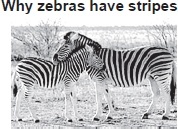
Scientists claim to have solved the mystery of why
zebras have their characteristic black and white stripes.
There have been many theories to explain the
zebra’s unmistakable stripes. Scientists have suggested
[5] that each zebra has a unique pattern that lets other
animals recognize it. Or that the mass of black and white
in a vast herd provides confusing camouflage that puts
off predators.
But the team that carried out the present study set
[10] out to test exactly what effect the stripes had on a zebra’s
most irritating and widespread enemy - the blood-sucking
horsefly. As part of their experiment the team put
sticky horse models — one white, one black and one
zebra-striped — into a fly-infested field. When they
[15] collected the flies that had landed and stuck to each of
the models, they found that the model zebra attracted
by far the fewest flies.
The researchers think that zebras had a blackcoated
ancestor, which evolved its white stripes in an
[20] evolutionary arms race, with an insect that’s become
the biting, disease-carrying plague of most horse herds.
WHY zebras have stripes. Disponível em: <http://www.telegraph.co.uk/news/earth/wildlife/10737443/Why-do-Zebras-have-stripes-Scientistsclaim- to-have-the-answer.html>. Acesso em: 12 out. 2015.
WHY zebras have stripes. Disponível em: <http://www.telegraph.co.uk/news/earth/wildlife/10737443/Why-do-Zebras-have-stripes-Scientistsclaim- to-have-the-answer.html>. Acesso em: 12 out. 2015.
Fill in the parentheses with T (True) or F (False).
Among the many theories that try to explain why zebras have stripes, the text mentions the following ones:
( ) Groups of zebras share the same pattern of stripes aiming to facilitate communication with one another.
( ) Each zebra has its own distinctive pattern so as to be easily identified by members of the herd.
( ) When getting together in large groups, their black and white stripes disorient predators and prevent them from approaching.
( ) The swinging movement of their black and white stripes scare predators, which mistake them for fierce wild animals.
The correct sequence, from top to bottom, is