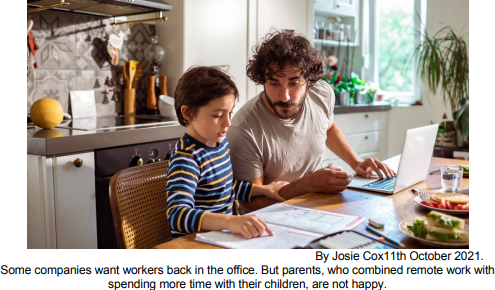
The parents who don’t want to go back to the office
For Ellen, a 36-year-old mother-of-one living in Westchester County, north of New York City, an article that
appeared online in May 2021 changed everything. That week, one of the most powerful men in the finance industry
told a conference that remote working didn’t work for “those who want to hustle”, and signalled his intent to bring
employees back to the office.
[5] Ellen, who had spent her entire career working on Wall Street, almost choked on her coffee. “During the previous
18 months, I’d spent every single waking hour of the day doing nothing but hustle,” she explains. She was worried by
what the comments implied for workers in her industry. “I didn’t want to go back to the office. I’d come to love working
from home. I’d proved that it could work, and I didn’t want it to change.”
But it did. In the weeks that followed, a handful of major financial-services companies, including Ellen’s employer,
[10] called time on allowing employees to choose where to work.
The pandemic, Ellen had rarely seen her three-year-old son during the week. But since Covid-19 hit, she had
become accustomed to having lunch with him and being around for bath and bedtime – which meant readjusting to
office working was “devastating”. “Through all the pain of the pandemic, the one huge upside was that I’d had a
chance to really bond with him,” she says of her son. “I was working, and we have a nanny, but I was at home and the
[15] opportunity to hang out with him between Zoom meetings and calls was priceless.”
For years, parents have been calling for more autonomy to decide where and when they work, and to construct
their working week around opportunities to care for their children. In March 2020, the pandemic granted those
requests for many, as people were sent home to do their jobs. But now, amid signs the pandemic may be coming
under control, and as a cautious transition back to pre-pandemic habits gathers pace, many employers are asking
[20] employees are to come back into the office full time.
Generally, workers are split on how they feel about going back in person. Some applaud the social advantages of
being back in the office, while others are recoiling at the prospect. But parents are fighting back particularly hard,
especially those who work long hours.
[...]
[25] According to a May 2020 survey by PwC, parents of children under the age of 18 were more reluctant to return to
the workplace than non-parents, and of all respondents who said they were hesitant to go back, more than a fifth cited
their responsibilities as a parent or caregiver. Additional PwC research in January 2021 showed that more than half of
employees would prefer to be remote at least three days a week once pandemic concerns subside.
Source: https://www.bbc.com/worklife/article/20211007-the-parents-who-dont-want-to-go-back-to-the-office. Accessed on: October 10, 2021. Adapted.
According to the text, it is CORRECT to state that: