WHEN IN THE AMAZON, PLEASE DO NOT PUNCH THE DOLPHINS
Vanessa Barbara
New York Times
01/Aug/2017
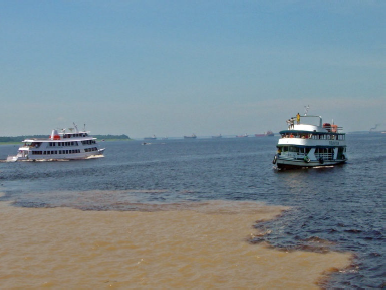
[1] The meeting of waters between the dark Negro River and the light-brown Solimões River is
impressive. No wonder it’s one of the main tourist attractions near the city of Manaus, capital of the state of
Amazonas. For several miles, the two gigantic rivers flow side by side without mixing because of their
difference in water composition, flow rate and density. (You can feel the variation of temperature by putting
[5] your hand in the water as the boat crosses the visually distinct line.) When the Negro and the Solimões
finally merge, they form the Amazon, the world’s largest river by discharge of water and one of the longest.
When I recently went on a boat tour in the Janauari Ecological Reserve, near the meeting of waters,
the boatman asked if I would also like to visit a family of ribeirinhos (riverside dwellers) who have a
caiman, a sloth and a snake. “You can take selfies with the animals, and later give them some gratification,”
[10] he told me, euphemistically suggesting tips for the people who keep the animals. I vociferously declined.
We resumed our navigation on the small motorboat through cool, peaceful igarapés (forest streams)
leading to dazzling igapós (swampy, flooded forests). It seemed as if a dam had ruptured somewhere and
the place was about to be submerged. Trees as high as buildings were half drowned by the river. The
boatman became less talkative, as if I’d offended him by refusing his last offer. I enjoyed the scenery; there
[15] was no need to hug illegally domesticated sloths.
Brazil still has a long way to go in the field of ecotourism. While in some places, as on the island of
Fernando de Noronha, in the northeast, the rules concerning wildlife preservation are strict, in others there is
less attention to long-term conservation and the ecological and social impact of tourism, often leading to the
pure and simple exploitation of animals, as well as local people and their cultures.
[20] One of the most profitable tourist activities in the Amazon is swimming alongside pink dolphins or
feeding them from a flutuante, a private floating deck, often situated within a national park. Tourists
regularly ride, restrain and harass the dolphins. Some even lift them out of the water for photographs.
(Sometimes this is done with the encouragement of a tour guide.) There are accounts of people being
accidentally bitten, and on one occasion, a man retaliated by punching the dolphin.
[25] A few years ago, a commission of federal agencies and research institutes issued local guidelines for
the activity — including the amount of food to be offered and the requirement that only tour guides could
feed the dolphins — but few people adhere to them. According to the owner of one flutuante, tourists must
only avoid touching the dolphin’s blowhole. (Please!)
There’s no federal legislation prohibiting feeding and touching the dolphins. As a result, their behavior
[30] has already changed: Many now survive on the frozen fish provided by tourism groups. They’re also
conditioned to stay close to the flutuantes and to humans. According to researchers, aggression is now
common among the dolphins. […]
Disponível em: <http://vps.latinamericanpost.com/article/when-in-the-amazon-please-do-not punch-the-dolphi/>. Acesso em: 1 ago. 2017. Adaptado.
Segundo o texto, é INCORRETO afirmar: