Read the text to answer question.
Brazil’s first homemade satellite will put an extra eye on dwindling Amazon forests
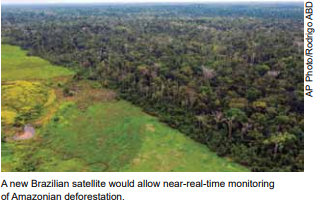
The fate of Brazil’s satellite program — and the country’s capacity to monitor disappearing Amazon forest — will be decided in 17 minutes and 30 seconds on February 28. That’s the time it will take to launch Amazonia-1, the first satellite entirely developed by the country. If the mission goes well, Brazil will join about 20 countries that have managed the whole chain of design, production, and operation of a satellite. Amazonia-1 will give researchers more frequent updates on deforestation and agricultural activity in the world’s largest tropical rainforest. Nevertheless, other challenges await, since Brazilian scientists deal with increasing cuts in research funding.
The satellite represents “a milestone for Brazil,” says Adenilson Silva, an engineer at Brazil’s National Institute for Space Research (INPE) who leads the mission and will oversee the launch at the Indian space center on the island of Sriharikota. The satellite’s development, which began in 2008, has involved more than a dozen Brazilian companies and an investment of 360 million reais ($60 million) — about one-sixth what it would cost to import ready-to-use equipment, Silva says. Amazonia-1 is the first of three Amazon-monitoring satellites INPE aims to build with the same manufacturing platform.
The new satellite is a 2.5-meter-long metallic cuboid weighing 640 kilograms. It’s loaded with 6 kilometers of cables and three wide−∠ cameras capable of detecting any area of deforestation bigger than four soccer fields. A planned launch in 2018 was postponed because of a lack of funding and delays in the supply of key components from collaborating companies.
(Sofia Moutinho. www.sciencemag.org, 26.02.2021. Adapted.)
In the excerpt from the first paragraph “Nevertheless, other challenges await”, the underlined expression refers to