The comfort food that took over the world
Every year, tens of billions of instant ramen noodles are enjoyed – a simple meal that only needs the addition of boiling water. Veronique Greenwood looks at the invention of a food revolution.
By Veronique Greenwood
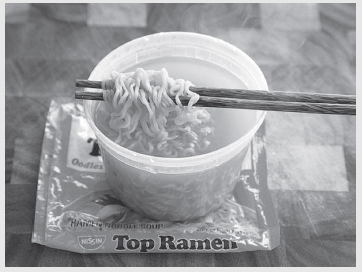
There was a time in my life when I ate a bowl of instant ramen every single day. When you’re a moody 13-year-old, sources of reliable satisfaction are in short supply, and when I wrote about it, I learned that I was not alone in relying on ramen to keep me afloat. Many readers wrote that it’s a comfort food for them too – easy to make, consistent, and surprisingly delicious.
At the International Museum of Ramen in Osaka, hordes of people come each year to pay homage. The museum features a timeline of hundreds of Nissin products, from Chikin Ramen to Spagheny to Cheese Curry Cup. The main attraction is an enormous hall where you can design and purchase your own Cup Noodles. My favorite oddity is a sculpture depicting— embedded in stone so as to suggest future archaeology—fossils, a cell phone, and a brilliantly colored Cup Noodles open and ready to eat, its noodles already held aloft by a plastic fork. A placard gives the sculpture’s title: “Eternal.”
Instant ramen can seem so elemental that it’s almost surprising to learn that it required inventing. But coming up with a shelf-stable, quick-cooking noodle soup was far from simple, or intuitive. The oft-told story of Momofuku Ando suggests it was difficult: the struggling Osaka businessman experimented for months in his backyard shed before launching Nissin in 1958.
The catalyzing insight was flash-frying the noodles after they had been boiled, seasoned, and dried. Frying them zaps away any remaining water, increasing their shelf life. But it also leaves the noodles threaded with a warren of empty space. The production technique also allows the noodles to be stored for up to six months without being refrigerated because the lack of water in the dried ramen prevents the spread of germs. When they’re tossed into boiling water again, the water rushes in, cooking them quickly and thoroughly in a few minutes. Ando was a colorful character, a middle-aged tinkerer who gradually became a sort of legend, as the price of instant ramen came down to more budgetfriendly levels. “
Ando promoted his product with a nearly religious zeal, as though he were on a crusade to feed the world – to end hunger with ramen,” wrote Karen Leibowitz in an essay about Ando for Lucky Peach. In 2000, when a Tokyo think tank put out poll for the most important Japanese innovation of the 20th Century, instant ramen won the title, leaving the Walkman, the bullet train, the digital camera, the fuel-efficient car, and the karaoke behind. (Pokemon was number eight, if you’re curious.)
Traditional Japanese cuisine is in many ways the polar opposite of instant noodles. At an old-fashioned inn in Kyoto I stayed at recently, dinner was nine small dishes brought out one-by-one, beginning with a tiny collage of octopus suckers and red beans. Slippery jellies, exquisitely fresh seafood, and crisply grilled fish followed. It was delicious, and could not have been farther from the ramen of my youth. But despite this, the convenient noodles are a national symbol.
They have blossomed abroad as well, with nearly 98 billion packages consumed globally in 2015, according to the World Instant Noodles Association. For years, Top Ramen, Maruchan Ramen, and Cup Noodles were almost the only varieties available in many Western markets, but that has changed. There has been an explosion in the types of noodles available in supermarkets and Asian groceries – you can get vegan instant noodles now, and there are flavors catering especially to the Mexican market.
Of course, some old habits die hard. At the museum in Osaka, thousands of people queue up to plop a brick of noodles into a Styrofoam cup, choose their own broth powder and dried toppings – everything from beef cubes, peas, carrots and dried fried onions – and have the whole thing sealed up to eat later. While no one would mistake it for high cuisine, it hits all those old, comforting notes— peculiarly satisfying.
(Adaptado de www.bbc.com, 27 de julho de 2016)
According to the information presented in the article, one can say about the author that: