Read the text to answer question.
Escaping from destruction
Almost 80 years ago Snowdonia, a mountainous region in northwestern Wales, United Kingdom, prepared to keep a welcome in the hillside for some of the world’s most treasured paintings. Across Europe the advancing Nazis had already looted or destroyed millions of pounds worth of art. As bombs fell on London and a German invasion seemed inevitable, attention turned to how to protect the National Gallery’s collection. In 1940, Winston Churchill famously said of the nation’s art treasures: “Hide them in caves and cellars, but not one picture shall leave this island.”
Experts scoured the UK for a hiding place — until they found Manod Quarry. Manod Mountain had been a working quarry1 for over a century. Its excavations created a cavernous space at the heart of the mountain, and covered with hundreds of feet of slate and granite it was virtually impregnable to bombing. Also, its very remoteness made it easier to keep the mission top secret.
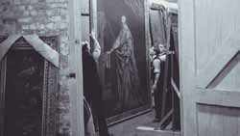
Suzanne Bosman, author of The National Gallery in Wartime, explains that moving almost 2,000 works by Leonardo da Vinci, Rembrandt, Van Dyck, and Turner proved to be quite an undertaking. “Cold, damp quarries aren’t really good storage places for priceless works of art, so before they were moved in, six air-tight climate-controlled brick huts were built inside the mountain,” she explained. “In fact the conditions in which they were stored at Manod were considerably better than those in which they were exhibited at the National Gallery before the war, and the evacuation taught staff a lot about preservation, even after the war”, says Bosman.
The largest paintings were packed in specially designed “elephant cases” and transported by road. The smaller paintings were transported in Post Office vans and delivery trucks in order to avoid attracting attention. However, Ms Bosman said, it did not always run that smoothly. “Van Dyck’s Equestrian Portrait of Charles I is a monster, at 12ft by 9.5ft, and in its case, loaded on the back of the truck, it was considerably taller. On the approach to the quarry there is a tight S-bend, just where the road passes under the arch of a railway bridge. I liken it to trying to get a sofa around a corner on the stairs; there was enough height, but only if you could hit precisely the right ∠.”
Nowadays the quarry is in a poor state of repair and access is strictly controlled. Inside you can still see the marks on the wall where the paintings hung, and the floor is littered with the hygrometers and thermometers which would have controlled every aspect of the conditions. It’s such a shame that very few people will get to see it in the future. We’ve let a piece of our national heritage slip away.
(This article was inspired by a question from reader Doug Cormack who got
in touch to ask how the National Gallery’s collection came to be evacuated
to Wales during the war, and whether the paintings would ever come back
to Wales for a commemorative exhibition.)
(Neil Prior. www.bbc.com, 19.05.2019. Adaptado.)
1quarry: an open excavation, usually for obtaining building material.
According to the second and third paragraphs, conservation of art work in Manod Mountain was made more difficult due to