TEXTO:
Jurassic bugs
Scientists say they’ve found the oldest bugs of their
type ever preserved in fossilized tree resin, in the Alps of
northern Italy. The finding by an international team of
researchers has been published in the Proceedings of
5 the National Academy of Science.
High in the Dolomites of northeastern Italy, Italian
researchers chipping away at rocks formed more than
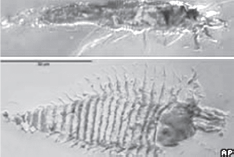
200 million years ago found two minuscule mites and a
fly preserved in tiny drops of amber. Highly-magnified
10 photographs of the creatures show the mites, in particular,
to be perfectly preserved. At 230 million years old, they’re
about 100 million years older than the oldest previous
find of their kind.
The bugs probably fed off the leaves of the tree in
15 whose resin they were eventually preserved. Researchers
say the discovery shows the mites’ ability to adapt to
changing evolutionary conditions. For film lovers, though,
it has striking echoes of the Stephen Spielberg
blockbuster, Jurassic Park, in which a team of scientists
20 use the DNA of a mosquito preserved in amber to recreate
dinosaurs with predictably terrifying results.
DUFF. Mark. Jurassic bugs. Disponível em: www.bbc.co.uk/worldservice/learningenglish/language/wordsinthenews/ . Acesso em: 8 dez. 2012.
“mites” (l. 8): cupins.
Fill in the parentheses with T (True) or F (False).
About the mites, it’s correct to say that they
( ) are extremely small.
( ) have been badly affected by time and weather.
( ) are the youngest mites ever found.
( ) have been able to adjust to changing evolutionary conditions.
According to the text, the correct sequence, from top to bottom, is