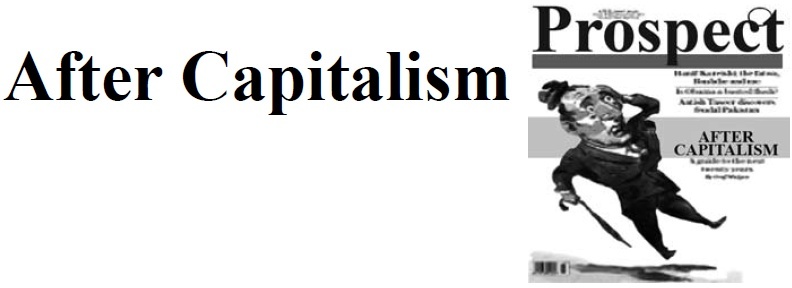
The era of transition that we are entering will be disruptive – but
it may bring a world where markets are servants, not masters.
To understand what capitalism might become, we first have
to understand what it is. This is not so simple. Capitalism includes
a market economy, but many traditional market economies are
not capitalistic. It includes trade, but trade, too, long precedes
capitalism. It includes capital – but Egyptian pharaohs and fascist
dictators commanded surpluses too.
The French historian Fernand Braudel offered perhaps the best
description of capitalism when he wrote of it as a series of layers
built on top of the everyday market economy of onions and wood,
plumbing and cooking. These layers, local, regional, national and
global, are characterised by ever greater abstraction, until at the top
sits disembodied finance, seeking returns anywhere, uncommitted
to any particular place or industry, and commodifying anything
and everything.
Only a few decades ago there was great interest in what would
supersede capitalism. The answers ranged from communism
to managerialism, and from hopes of a golden age of leisure to
dreams of a return to community and ecological harmony. Today
these utopias can be found in the movements around the World
Social Forum, on the edges of all of the major religions, in the
radical sub-cultures that surround the net, and in moderated form
in thousands of civic ventures across the world.
MULGAN, Geoff. Available at: <http://www.prospect-magazine.co.uk/articledetails.php?id=10680> Access on June 17th, 2009
We can say that the author of the text thinks that religion