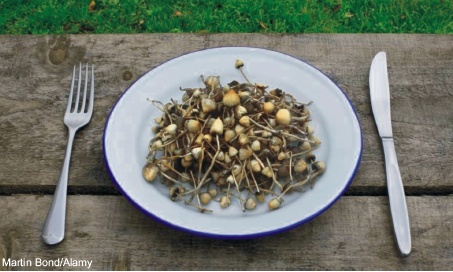
Kick Your Smoking Habit With... Magic Mushrooms?
By Paula Mejia
Filed: 9/11/14 at 5:42 PM
In: http://www.newsweek.com/kick-your-smoking-habit-magic-mushrooms-270012
[1]- A small group of longtime smokers were able to kick
their nicotine habit after taking psilocybin – the same
hallucinogenic present in magic mushrooms – in a
cognitive behavioral therapy treatment program at
Johns Hopkins University School of Medicine,
according to a report published in today's Journal of
Psychopharmacology. All 15 participants had tried
to quit smoking cigarettes before, with nicotine
replacement and drugs alike, and all had failed.
[2]- Five women and 10 men, roughly around 51 years
old, participated in the study. On average, the
lifelong smokers had smoked 19 cigarettes a day for
31 years. Five participants had never tried the mindaltering
drug, while 10 participants said they had
used it (recreationally) in the past. After briefing
them on psilocybin's effects, researchers gave
participants the drug in three separate doses, the
first of which was given to them the day they planned
to go cold turkey on cigarettes. Participants were
given the second dose two weeks after the initial
dose and the third eight weeks later.
[3]- With each dose, researchers increased the amount
of psilocybin administered. In each of the
individualized, six-to-seven-hour sessions,
participants were told to relax and reflect on their
experiences. Two researchers kept an eye on the
subjects, many of whom listened to music
throughout.
[4]- Matthew W. Johnson, an associate professor of
psychiatry and behavioral sciences at Johns
Hopkins and study co-author, said in a press release
that the rate of nicotine abstinence for the study's
participants stood at 80 percent after six months, a
markedly higher rate than typical success rates in
smoking cessation trials. Varenicline, typically
considered the drug most effective in curbing a
smoking habit, has demonstrated only a 35 percent
success rate after six months. Nicotine replacement
and behavioral therapy alone, by contrast, usually
have a success rate of less than 30 percent.
Researchers note that the benefits last even after
participants came down from the mind-altering drug.
[5]- The research initiative is part of a federally funded
cognitive-behavior smoking-cessation program. Yet
the study's authors caution people against “do-ityourself”
drug use, stating that the results were the
result of controlled doses in a treatment program. If
administered responsibly in a cognitive behavioral
therapy program, however, the researchers suggest
that psilocybin can be an effective tool for smoking
cessation, as it may help to deconstruct patterns of
behavior and thoughts after years of being addicted
to cigarettes.
[6]- In a Washingtonian profile published earlier this year,
Johnson said that he was inspired by previous
studies that linked hallucinogens to the effective
treatment of serious heroin and alcohol addictions.
The mind-altering drug reportedly causes users to go
into reflective states of sublimity, in which they accept
new perspectives. Citing anecdotal evidence,
Johnson told the paper that people would sometimes
stop smoking after using psilocybin recreationally,
perhaps after experiencing a kind of spiritual
awakening. “They'll say, 'Lo and behold, I had a
cigarette in my hand and thought: What in the world
have I been doing?' Psilocybin opens a window of
opportunity with a very altered experience of oneself
and of oneself in the world,” he said.
[7]- The study touches upon the same ethos of
traditional treatment programs, such as Alcoholics
Anonymous, encouraging spirituality as part of the
rehabilitation process. Johnson's method combines
the spiritual connection with cognitive behavioral
therapy.
[8]- "Quitting smoking isn't a simple biological reaction
to psilocybin, as with other medications that directly
affect nicotine receptors," Johnson said in a press
release. "When administered after careful
preparation and in a therapeutic context, psilocybin
can lead to deep reflection about one's life and
spark motivation to change."
[9]- Johnson plans to use the drug for his next study,
which will cross-reference MRI scans of people who
used nicotine patches to successfully stop smoking
as compared to those who took psilocybin and
successfully quit.
De acordo com o texto, o experimento descrito associa