Refugees in Germany
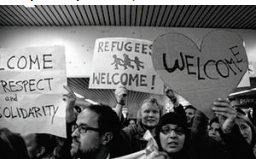
Cheering crowds greeted the new arrivals and handed out toys and chocolate as they filed off trains and into tents for basic medical checks.
They are then taken by bus to conference centres, school halls and other large spaces that have been pressed into service as temporary housing centres, part of a complex system for managing the influx set up almost overnight. Dieter Reiter said he was surprised at how effectively his city had responded to the crisis. The mayor said: “Of course there are some limits in response to the space we have in Munich but that is not the question I am asking myself.”
“Every day I am asking myself how can we accommodate these people, these refugees, how can we give them a feeling that they are safe here in Munich, here in Germany. I am not really thinking about how many people can we afford and can we take here in Munich. That is not the question,” he told journalists at a news conference.
On Saturday 6,780 people arrived in Munich on trains, many of them from the large group that had set off to walk from Budapest after days stranded at a train station in the Hungarian capital. After a long day’s march, most were picked up by buses and taken to the border, but many arrived exhausted and ill. The city is expecting another 4,000 people to arrive on Sunday. The first 1,200 came in the early hours of the morning, but their trains were diverted straight away to other German cities, including Frankfurt, to ease the pressure on Munich.
There were so many well-wishers at Munich’s station that police had to push back barricades to give those arriving more space, and volunteers were turning away people with clothes to donate away. Many of those at Munich station think maybe Germany should act as a role model for other nations and Robert Bogner, a Munich’s citizen, says: “These people have left enough behind.”
Disponível em: http://www.theguardian.com/world/2015/sep/06/munich-mayor-i-dont-think-about-numbers-only-refugees-safety. Acesso em: 04/10/2015, às 17h (adaptado).
According to Munich’s Mayor,