Leia o texto para responder a questão.
The fantastic appeal of fantasy
Few things can brighten up a dark morning in a Scottish seaside resort during an Atlantic storm. Yet while sheltering in a bookshop from the rain, I had a moment of sunny revelation. Stacked almost as high as my 11-year-old self were copies of The Lord of the Rings, with a cover illustration that promised mystery and magic. That chance discovery started a lifelong love of the fantasy genre1 , both as reader and writer.
The fantasy genre has had more and more success, but today we’re in the middle of an unprecedented fantasy boom. Sales continue to rise and it is now the biggest genre in publishing. The more rational the world gets, with super-science all around us, the more we demand the irrational in our fiction.
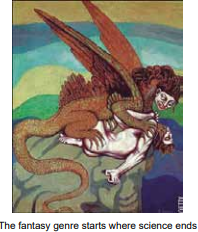
Fantasy is not simply a case of swords2 and sorcery3 . Yes, there is that by the shelf. But the genre is as broad as the imagination. The genre starts where science ends.
“In these modern times, where most of us sit at computers, fantasy books offer a chance to break out of mundane moments,” says Mark Newton, an editor with the genre. “People like to explore themes that go beyond the limited palette that literary fiction claims to offer.”
A search for the origins of fantasy will usually have academics muttering about Beowulf or Homer’s The Iliad, but they come from a time when all stories were fantasy: gods and monsters and supernatural artefacts with humanity caught in the middle. The first modern fantasy writer is usually considered to be William Morris, in the late 19th Century. But it was the early 20th Century where fantasy really started to gain status.
Fantasy fiction has always been about visionary ideas. You can get artful words in plenty of literary fiction, but being able to see beyond the boundaries4 of the world around us — now that’s a special skill.
I don’t write fantasy fiction simply to provide a trapdoor 5 from the real world. For me, the genre is about the reality. But instead of coming up against it, fantasy maps the unconscious aspirations of our modern society through allegory in story- -forms as old as humanity. It’s about turning off the mobile phone and the computer and remembering who we are in the deepest parts of ourselves.
(Mark Chadbourn. www.telegraph.co.uk, 12.04.2008. Adaptado.)
1 genre: gênero. Categoria distintiva de composição literária, como romance, poesia etc.
2 sword: espada.
3 sorcery: feitiçaria.
4 boundary: fronteira.
5 trapdoor: alçapão.
In the excerpt “that’s a special skill” (6th paragraph), the underlined word can be replaced, without changing the meaning of the sentence, by