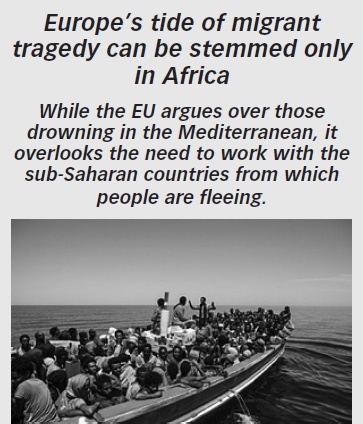
‘Over 1,800 migrants have died in the Mediterranean since the beginning of 2015.’ Photograph: Jason Florio/ AFP/Getty Images
One day in October 2013, Enrico Letta, the then ′ minister of Italy, stood in front of 302 coffins lined up inside a ventilated room on the island of Lampedusa. They contained the bodies of those who had perished at sea, in the biggest migrant disaster Europe had known at that point.
Some of the coffins were very small: they contained the bodies of children. It was a moment of deep reckoning. Letta suddenly realized that Europe’s indifference, and its powerlessness, had created a situation where thousands of human lives were put at risk. For Letta, that day marked the starting point of Mare Nostrum, an operation Italy launched to search and rescue migrants attempting the perilous crossing from Africa to Italy.
Letta tells this story in his recent book Andare insieme, andare lontano [Going Together, Going Far], in which he describes his experience as head of the Italian government in 2013-14. He says the migrant crisis became the “gravest issue” he had to deal with as ′ minister. But, as Letta points out, doing something about those deaths wasn’t just about putting an end to our shame or sense of guilt. It had to do with a certain conception of civic and political duty. Those boat people in the Mediterranean came as a reminder that there were things that simply had to be done: there were moral obligations. But the fact is also that Italy ended up alone in bearing the brunt of the effort.
A lot of this came back to the fore in recent weeks, as even worse mass drownings have occurred off the Italian coast. More than 1,800 people have died in the Mediterranean since the beginning of the year. European ministers have scrambled to produce a list of possible measures, ranging from mandatory national quotas for refugees to the military targeting of trafficking networks in Libya, the country that acts as the biggest launchpad for migrants.
The deeper problem is that only the downstream aspect of the migrant tragedy is being addressed. The issues at the other end – where these migrants come from, and why – have hardly been studied in depth, or with strategic solutions in mind. There has been much focus on the resources for rescue operations, on the situation in Libya, its traffickers and its boats, and on how many asylum seekers will be taken in by European countries. But just as Letta wrote in his book, there is a much larger issue at play here, and one that no one seems quite ready to confront: the question of why millions of people decide to uproot themselves from Africa in search of a better life in Europe.
Concentrating on Syrian war refugees, many of whom now arrive in Europe via other routes, misses a bigger story: the largest group of people crossing the Mediterranean to get to Europe this year were those from sub-Saharan Africa. One Rome-based European official went as far as claiming that “90% to 95% of migrants” who arrived on Italian shores in recent months had come from countries in western and sub-Saharan Africa such as Senegal, Mali or Ivory Coast. These are not necessarily war refugees, but often young men fleeing poverty, unemployment, repression and corrupt
The pronoun this (boldfaced in the text), in the sentence “A lot of this came back to the fore in recent weeks, (…)”, refers to: