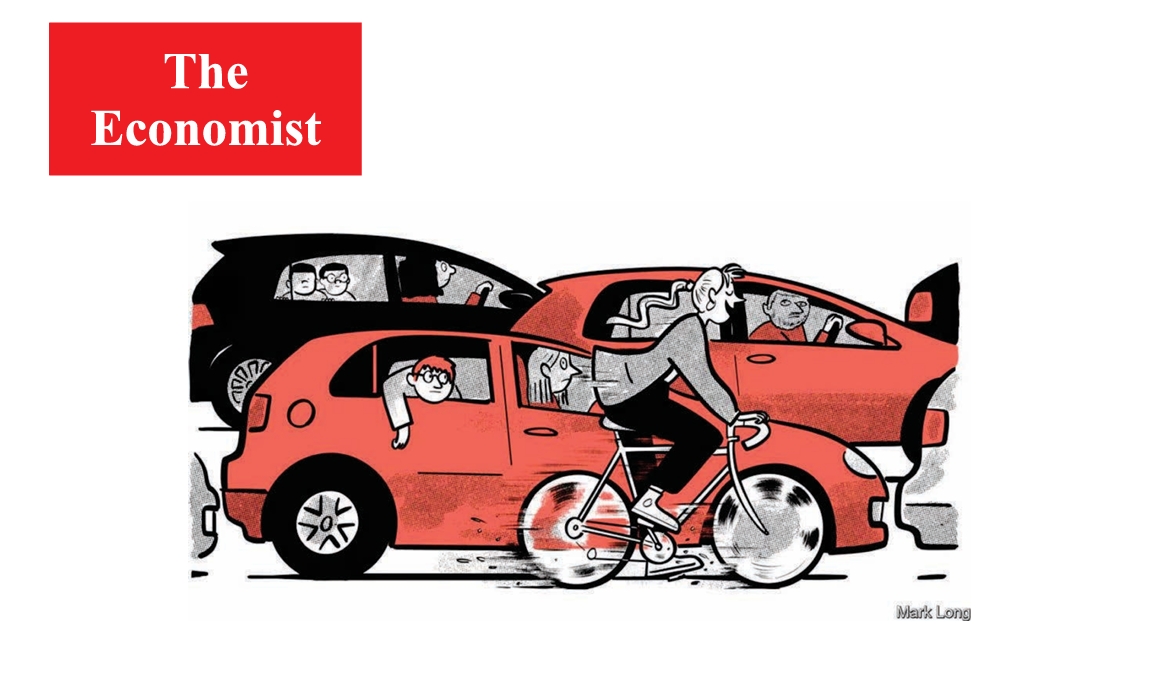
For Adah Crandall, a high-school student in Portland, Oregon, a daily annoyance is family members asking when she is going to learn to drive. Ms Crandall, who is 16, has spent a quarter of her life arguing against the car-centric planning of her city. At 12 she attended a school next to a major road down which thousands of lorries thundered every day. When a teacher invited a speaker to talk about air pollution, she and her classmates were galvanised. Within a year, she was travelling to Salem, Oregon's capital, to demand lawmakers pass stricter laws on diesel engines.
Yet her family still nags her to get her driver's licence. "[It's] seen as this ticket to independence. It's so glorified," she says. Ms Crandall admits her life would be easier if she had access to a car—she would spend less time on buses and could drive to the coast with her friends. But she hates the idea that she should have to. "Why in our society is our identity so tied to car use?" she asks. "If I choose to comply and get my driver's licence it would be like giving in."
Few technologies defined the 20th century more than the car. On the surface, the love affair with the personal automobile continues unabated into this century. The number of drivers on the world's roads continues to rise almost everywhere. The distance driven by American motorists hit a new peak last year, according to data from the Federal Highway Administration. But there are hints that this is changing. People like Ms Crandall show why. Getting a driving licence was once a nearly universal rite of passage into adulthood. Now it is something that a growing minority of young people either ignore or actively oppose, into their 20s and beyond.
https://www.economist.com/international/2023/02/16/throughout-the-rich-world-the-young-are-falling-out-of-love-with-cars (adapted)
Na frase "When a teacher invited a speaker to talk about air pollution, she and her classmates were galvanised.” (1.º parágrafo), o termo “galvanised” poderia ser substituído, sem prejuízo de sentido, por
Resolução passo a passo com explicação detalhada
Inglês > Inglês > Interpretação de Texto
Interpretação de Texto aparece em ~71% das questões de Inglês (11704 questões no banco).
UFRGS 2026
Questão 10
Instrução: As questões de 09 a 15 estão relacionadas ao texto abaixo. Do all peo
FCMSCSP 2026
Questão 11
Read the text to answer questions from 11 to 14. New York Giants wide receiver M
Albert Einstein 2026
Questão 11
Texto sobre o experimento Biosphere 2, uma estrutura no deserto do Arizona que t
Albert Einstein 2026
Questão 12
Texto sobre o experimento Biosphere 2, uma estrutura no deserto do Arizona que t
