Leia o texto para responder à questão
Reuters photographer Nacho Doce has documented the mangrove forests in Cairu, Brazil. He visited a community of mud houses along the edge of the Caratingui River, known as The Train because the single-file homes look like train carriages.
Mangroves cover 13,989 sq km of Brazil’s coast and are an important protection against climate change, with one acre of mangrove forest absorbing nearly the same amount of carbon dioxide as an acre of Amazon rainforest.
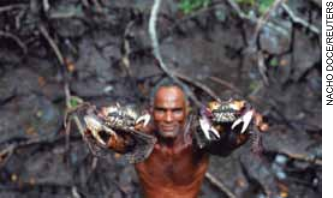
Fisherman Jose da Cruz makes his living by fishing for crabs where freshwater rivers meet the brackish Atlantic Ocean. Instead of a rod or a net, he uses his hands to search for crabs in the mud among the mangrove trees, sometimes lying flat on the ground and reaching deep down. His daily catch of several dozen crabs will earn him 200 reais (£40) a week, enough on which to survive. Mr Da Cruz says his daily catch is half what it was 10 years ago and in that time the water line has advanced 3m (10ft) inland.
According to climate researcher Carlos Nobre, at the University of Sao Paulo, water levels have risen 20-30cm (1ft) over the past 100 years in coastal Bahia state. Scientists predict the global surface temperature will have risen by more than 1.5C by the end of the 21st Century. And some prediction models in a 2014 report say this temperature increase will actually exceed 2C, without unprecedented changes within human societies. “Nature is upset”, Mr da Cruz says.
(www.bbc.com, 13.06.2019. Adaptado.)
No trecho do terceiro parágrafo “Instead of a rod or a net”, a expressão sublinhada expressa a ideia de