[1] “BING” GETS FRIENDLIER WITH “FACEBOOK”
[2] New features will push the Microsoft search engine ahead of Google in the race to make search more social.
[3] Starting tomorrow, recommendations from your Facebook
[4] friends will become a regular part of Web search results, at
[5] least if you use Microsoft’s Bing search engine. A slew of new
[6] Bing features will use Facebook data to make its results more
[7] personalized, and to create opportunities to discuss what you
[8] are searching for with friends.
[9] “All the stuff we’ve deployed previously for Web search doesn’t
[10] acknowledge the human, social side of our users,” says Stefan
[11] Weitz, director of Bing search. “We were looking at it like
[12] engineers, and built a purely logic-based experience,” Weitz
[13] says. Web search should support people’s instincts to consult
[14] and discuss things with other people. A survey of Bing users found that 90 percent would talk with a friend before they
[15] acted on any information they found when searching online for product information, he says.
[16] The new features will push Bing ahead of Google in the race to make search more social. Last month, Google launched
[17] +1, its own close analogue of the Like button, with the intention of using it to shape search results. However, +1 is off to
[18] a slow start, because it is not hitched to a large social network, giving users little motivation to use it.
[19] Bing’s new features primarily use data that comes from the clicks on Facebook’s Like buttons. These buttons appear on
[20] sites across the Web. The Like button started as a low-cost way to communicate recommendations with friends online,
[21] but in recent years, it’s been adapted by Facebook to drive the ambitious “open graph” project, whose goal is to
[22] intertwine Facebook’s network of connections with the Web.
[23] Bing has been using data on the likes of users’ friends in its results since October, adding a box featuring relevant links
[24] liked by Facebook friends to some search results. Now these likes will have a much more visible effect on search results.
[25] The profile pictures of friends will appear next to search results that they have liked. Those likes will also be used to
[26] promote pages that otherwise may not have appeared on the first page of results.
[27] Other new features are intended to make search into a communication tool that can connect you with existing Facebook
[28] contacts or new ones. Searching for people – even those you are not linked with directly – may now return a short bio taken
[29] from Facebook profiles. This could include information like the person’s location, school, and employer.
[30] When a user searches for a city, Bing will highlight friends that Facebook says are located nearby. This presumably
[31] would allow you to connect with people who might have recommendations about places to stay or visit, or friends you
[32] might want to inform about your visit.
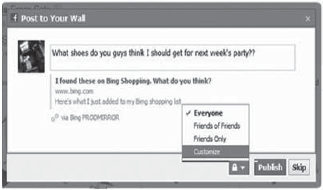
[33] Bing’s product search engine will also include new Facebook features. It will be possible to post a short list of possible
[34] purchases to your Facebook wall, to encourage friends to help you choose. “This turns search into a conversation, and
[35] makes it a less passive experience,” says Weitz.
[36] Bing’s new features can only access information if your Facebook privacy settings will allow it. Research on neurobiology
[37] and social psychology helped guide Bing’s new direction, says Weitz, who claims the approach will help make decision
[38] making easier. Traditional Web search triggers an unhelpful phenomenon known as “decision quicksand,” says Weitz.
[39] The term describes how people come to think of decisions as more important _________ they really are because of the
[40] complexity of weighing all the evidence. “When you use traditional Web search, your brain thinks everything is really
[41] important because there are half a million results you are told are relevant and have to deal with,” says Weitz. “What
[42] we’re doing now is using social signals to simplify that so your brain isn’t tricked.”
By Tom Simonite / Massachusetts, Technology Review, MIT, 16/05/2011
Adapted from http://www.technologyreview.com/web/37585/?mod=chfeatured
Neste artigo, o título “Bing” gets friendlier with “Facebook” (linha 1) significa que