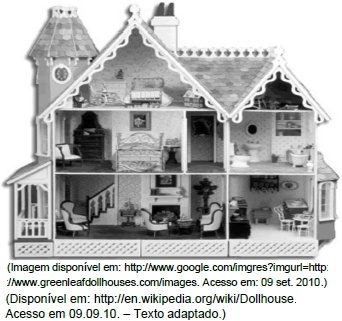
DOLLHOUSE
[1] A dollhouse is a toy home, made in miniature. For the last century, dollhouses have primarily been the
domain of children but their collection and crafting is also a hobby for many adults.
Today's dollhouses trace their history back about four hundred years to the baby house display cases of
Europe, which showed idealized interiors. Smaller doll houses with more realistic exteriors appeared in Europe in the
[5] 1700s. Early dollhouses were all handmade, but following the Industrial Revolution and World War II, they were
increasingly mass produced and became more standardized and affordable.
Miniature homes, furnished with domestic articles and resident inhabitants, both people and animals, have
been made for thousands of years. The earliest known examples were found in the Egyptian tombs of the Old
Kingdom, created nearly five thousand years ago. These wooden models of servants, furnishings, boats, livestock
[10] and pets placed in the Pyramids almost certainly were made for religious purposes.
The earliest known European dollhouses were the baby houses from the Sixteenth Century, which were
cabinet display cases made up of rooms. They showed idealized interiors complete with extremely detailed
furnishings and accessories. The cabinets were built with architectural details and filled with miniature household
items and were solely the playthings of adults. They were off-limits to children, not because of safety concerns for the
[15] child but for the dollhouse. Such cabinet houses were trophy collections owned by the few matrons living in the cities
of Holland, England and Germany ________ were rich enough to afford them, and, fully furnished, were worth the
price of a modest full-size house's construction.
The early European dollhouses were each unique, constructed on a custom basis by individual craftsmen.
With the advent of the Industrial Revolution, factories began producing toys, including dollhouses and miniatures
[20] suitable for furnishing them. Germany was the producer of the most prized dollhouses and their furnishings up until
World War I. Notable German miniature companies included Märklin, Rock and Garner and others. Their products
were not only avidly collected in Central Europe, but regularly exported to Britain and North America. Germany's
involvement in World War I seriously impeded both production and export. New manufacturers in other countries
arose. The TynieToy Company of Providence, in the U.S.A., made authentic replicas of American antique houses and
[25] furniture in a uniform scale beginning in about 1917. Dollhouse dolls and miniatures were also produced in Japan,
mostly by copying original German designs.
After World War II, dollhouses became mass produced in factories on a much larger scale than ever before,
even though with less detailed craftsmanship. By the 1950s, the typical dollhouse sold commercially was made of
painted sheet metal and contained plastic furniture. Such houses cost little enough so that the great majority of girls
[30] from the developed western countries that were not struggling with rebuilding after World War II could own one.
In the United States, most houses have an open back and a fancy front façade, while British houses usually
have a front part that opens to reveal the rooms.
Assinale a alternativa que completa adequadamente a lacuna do texto na linha 16.