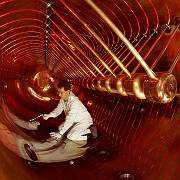
Green Light for New Particle Accelerator
One way to figure
out what might have
happened during the Big
Bang — that massive
[5] explosion of matter and
energy that physicists
think might have marked
the birth of the universe —
is to spend hours in front
[10] of a chalkboard working
through massively complicated formulae.
The other, of course, is to go out and create a
Big Bang yourself. That is the route to be taken by
German researchers along with their particle physics
[15] colleagues from over a dozen countries around the
world. On Wednesday, those participating in the
project will sign an agreement which will eventually
result in the construction of a massive new particle
accelerator in the western German city of Darmstadt.
[20] The goal is to discover new data about the birth of our
universe.
"The substance we will be making resembles
that in the first microseconds of the Big Bang, when it
was a million times hotter than the center of the sun.
[25] We're talking a million times 10 million degrees
Celsius", says Horst Stöcker, scientific director of the
German Society for Heavy Ion Research (GSI).
The project will cost a total of €1.2 billion ($1.7
billion) with the German government set to pick up 65
[30] percent of the price tag. The rest will come from the
state of Hesse and from the project's international
partners, which include Russia, India, Italy, Poland
and China among others. The accelerator itself will
have a circumference of over a kilometer and will be
[35] built 17 meters underground.
http://www.spiegel.de/international/germany/0,1518,druck-515900,00.html
Relate the numbers in the first column to their corresponding reference in the second column. After that, choose the alternative that presents the correct sequence.
First column
I) dozen
II) 1.7 billion
III) 65
IV) 17
Second column
( ) Countries around the world involved in the project.
( ) Percentage of the price tag paid by the German government.
( ) Total cost of the project.
( ) Meters underground where the accelerator will be built.