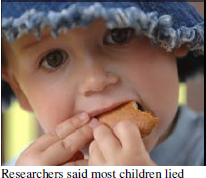
Toddlers who lie 'will do better'
[1] Toddlers who
tell lies early
on are more
likely to do well
[5] later, resear-
chers claim.
The complex
brain processes
involved in for-
[10] mulating a lie
are an indicator
of a child's early
intelligence, they
add. A Canadian study of 1,200 children aged two
[15] to 17 suggests those who are able to lie have
reached an important developmental stage. Only a
fifth of two-year-olds tested in the study were able to
lie. But at age four, 90% were capable of lying, the
study found. The rate increases with age to a peak
[20] at age 12.
'Developmental milestone'
The director of the Institute of Child Study at
Toronto University, Dr Kang Lee, said: "Parents
should not be alarmed if their child tells a fib.
[25] "Their children are not going to turn out to be
pathological liars. Almost all children lie.
"It is a sign that they have reached a new
developmental milestone.
"Those who have better cognitive development lie
[30] because they can cover up their tracks."
This was because they had developed the ability
to carry out a complex juggling act which involves
keeping the truth at the back of their brains.
He added: "They even make bankers in later life."
[35] Dr Kang tested the children's honesty by telling
them not to peek at a toy placed behind their backs
while leaving the room.
He then monitored their reactions by video and
returned to ask if they had turned around, checking
[40] their responses against the recording.
http://news.bbc.co.uk/2/hi/education/10119297.stm Page last updated at 10:55 GMT, Monday, 17 May 2010 11:55 UK
No título do texto, Toddlers who lie 'will do better', o emprego de “will” sugere claramente um(a)