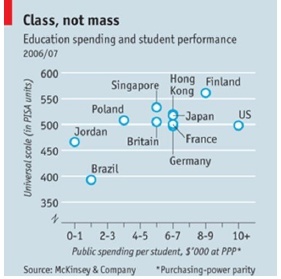
America, for example, increased its spending on schools by 21% between 2000 and 2007, while Britain pumped in 37% more funds. Yet in this period, according to PISA, standards in both countries slipped […].
TEXT 1
It is not money nor uninformed reform that makes schools better
EDUCATION is the handmaiden of economic growth: teach future workers well, it is argued, and they will go on to invigorate the economy. No surprise then that the OECD, a club of mostly rich countries, goes to great lengths to discover how the school systems in its member countries are doing. Education ministers are already anxiously awaiting the next issue of its PISA study, which is due to be published on December 7th. As happens every three years, this will detail and rank the reading, mathematics and science skills of 15-year-olds in each country.
But even more important than ranking school systems is knowing how to make them better. That is the aim of another new study, to be released on November 29th by McKinsey. The consultancy selected school systems where it has seen standards rise and identified what they had in common. Countries can make rapid progress, it argues, if they do the right thing—and at the right time.
For starters, McKinsey says, throwing money at education does not seem to do much good, at least in those countries that already send all their young people to school (see chart). America, for example, increased its spending on schools by 21% between 2000 and 2007, while Britain pumped in 37% more funds. Yet in this period, according to PISA, standards in both countries slipped.
Many school systems that were not showered with extra funds did much better. Schools in the state of Saxony, in Germany, in Latvia, Lithuania, Slovenia and Poland have all raised their games. Even poor countries such as Chile and Ghana have made progress.
What separates the big spenders from the improvers, McKinsey found, is the awareness that different types of school system respond to radically different types of reform. In countries where schools mainly seek to teach pupils to read, write and grasp some basic maths, centralization seems to work. All teachers should be directed to teach the same lessons from the same textbooks.
Countries where schools have already attained a higher standard should become pickier in choosing teachers. Another study by McKinsey in 2007 concluded that making teaching a high-status profession was what boosted standards. For instance, schools could recruit teachers from among the best university graduates, an idea that was part of a series of measures published in England on November 24th.
At the very top of the global educational league table — where only a handful of countries or systems within them manage to attain really high standards — decentralization is the name of the game. The authorities hand control over to teachers, most of whom are highly educated and motivated, so they can learn from each other and follow the best practices. When it comes to getting the very best grades, it seems that teacher still knows best.
Disponível em: <www.economist.com>.
Com base no trecho acima é correto concluir que, entre os anos de 2000 e 2007,