TEXTO:
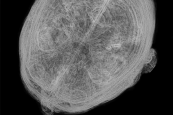
Transparent Thinking
The image of a whole brain has been rendered before
from bits and pieces, whether illuminated by radiology
or cut into slivers with cold steel blades. But chemical
engineers and neuroscientists at Stanford University have
[5] now developed a process that renders the organ of thought
quite literally transparent.
To be sure, the technique called “Clarity” has been
used thus far mainly to study postmortem mouse brains,
but testimonials already are accumulating. Thomas Insel,
[10] director of the National Institute of Mental Health, says
the process “transforms the way we study the brain’s
anatomy and how disease changes it.” He claims that
“in-depth study of our most important three-dimensional
organ” will no longer be “constrained by two-dimensional
[15] methods.” “Ordinarily, brain tissue must be sliced
into very thin layers for study. But that can distort
the cells and their connections. The new method —
Clear Lipid-exchanged Anatomically Rigid
Imaging/immunostaining-compatible Tissue Hydrogel
[20] (CLARITY) — retains support for brain cells and their
interconnections, down to the molecular level. More
importantly, CLARITY permits the scientists to label
antibodies and repeatedly stain and de-stain tissues
without disturbing them.” [Psychiatric News Alert]
[25] Team leader Karl Deisseroth says the process may
eventually be applicable for research on many kinds of
tissue and “any biological system.” The innovation is
the replacement of fatty cells called lipids, which make
the brain opaque and obscure its dense neural
[30] connections, with a substance called hydrogel, which is
transparent. The “clarified” brain, as the Stanford team
calls it, can then be treated with fluorescent dyes that
light up specific circuitry. The detail is extraordinary, right
down to the molecular level.
DICKEY, Cristopher. Transparent Thinking. In: Big Think: Around the world in six ideas. Newsweek, May 13 & 20, 2013, p.8-9. Adaptado
Fill in the parentheses with T (True) or F (False).
About the CLARITY technique, it’s correct to say:
( ) It is regarded as a major breakthrough in the neuroscience field.
( ) It is capable of providing a thorough and detailed analysis of the whole brain.
( ) It enables the scientists to observe the brain in both its whole form and at the cellular level.
( ) It preserves the brain’s most minute structures as its tissues suffer no damage, which is likely to happen through the slicing process.
According to the text, the correct sequence, from top to bottom, is