Zika, Ebola outbreaks can be predicted using
climate change, scientists say
Jamie A.
June 14, 2016
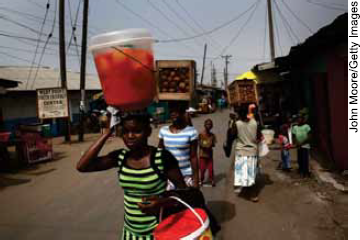
Women walk with their wares through the West Point slum on February 9, 2016 in Monrovia, Liberia. West Point, the most impoverished and overpopulated community in Liberia, was hard hit by the Ebola outbreak, and health facilities at the time were overwhelmed. After almost two years, on January 14, 2016 the World Health Organization declared the epidemic over, after the virus had killed some 11,300 people and infected more than 28,500 people in West Africa.
Scientists in the UK said that Zika and Ebola outbreaks could be predicted based on changes in the environment. Researchers at the University College London (UCL) developed a model that can predict outbreaks of zoonotic diseases – such as Zika and Ebola that came from animals – based on changes in climate, population growth and land use.
The study, which was published in Methods in Ecology and Evolution, is described as “a major improvement in our understanding of the spread of diseases from animals to humans,” and the researchers said that the study could help governments prepare and respond to outbreaks, as well as consider the environmental risks when making policies. “Our model can help decision-makers assess the likely impact (on zoonotic disease) of any interventions or change in national or international government policies, such as conversion of grasslands to agricultural lands,” Kate Jones, professor at the University College London’s genetics, evolution and environment department and co-author of the study, said in a press release. According to the study, more than 60 percent of emerging infectious diseases are zoonotic by nature, and that aside from Zika and Ebola, other highly infectious diseases such as Rift Valley fever and Lassa fever are predicted to spread with changing environmental factors.
Researchers tested the new model with the Lassa fever epidemic in West Africa, which was caused by the Lassa virus from rats. The team used the locations of 408 known Lassa fever outbreaks in West Africa between 1967 and 2012 and the changes in land use and crop yields, temperature and rainfall, behavior and access to healthcare.
To track the virus’ location against ecological factors, the researchers also identified the sub-species of the multimammate rat (Mastomys natalensis) responsible for transmitting the virus. With these information, the model predicts that the number of people infected by the disease will double from 195,125 to 406,725 by 2070.
“Our new approach successfully predicts outbreaks of individual diseases by pairing the changes in the host’s distribution as the environment changes with the mechanics of how that disease spreads from animals to people, which hasn’t been done before,” Dr. David Redding of UCL and co-author of the study said in the press release. “It allows us to calculate how often people are likely to come into contact with disease-carrying animals and their risk of the virus spilling over. Alongside population increases, the expected future changes to climatic patterns will drive an expansion of the areas of West Africa considered high risk, especially the western most regions around Senegal and Guinea, the coastline of Cote d’Ivoire and Ghana, and in Central Nigeria,” Redding added. According to the researchers, the model could be refined to include the impact of travel infrastructure, human-to-human contact rates and poverty.
(www.natureworldnews.com. Adaptado.)
No trecho do último parágrafo “It allows us to calculate how often people are likely to come into contact with disease-carrying animals and their risk of the virus spilling over”, o termo em destaque refere-se a