Leia o texto para responder à questão.
Airborne particles cause more than 3m early deaths a year
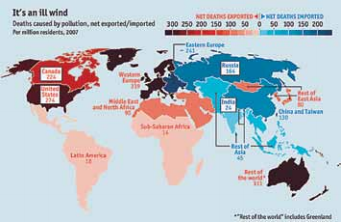
Governments are worried over traffic and other local nuisances that create filthy air. But research just published in Nature by Zhang Qiang, of Tsinghua University in Beijing, and an international team including environmental economists, physicists and disease experts, suggests the problem has a global dimension, too. Dr Zhang’s analysis estimates that in 2007 — the first year for which complete industrial, epidemiological and trade data were available when the team started work — more than 3m premature deaths around the world were caused by emissions of fine particulate matter (known as PM2.5, because the particles in question are less than 2.5 microns across).
Of these, the team reckon just under an eighth were associated with pollutants released in a part of the world different from that in which the death occurred, thanks to transport of such particles from place to place by the wind. Almost twice as many (22% of the total) were a consequence of goods and services that were produced in one region (often poor) and then exported for consumption in another (often rich, and with more meticulous environmental standards for its own manufacturers).
In effect, such rich countries are exporting air pollution, and its associated deaths, as they import goods. As far as China is concerned, that phenomenon is probably abating. Chinese coal consumption has been on the wane since 2013, so premature deaths there from toxic air are now probably dropping. But other industrialising countries, such as India, may yet see an increase.
(www.economist.com, 01.04.2017. Adaptado.)
De acordo com o terceiro parágrafo, a China