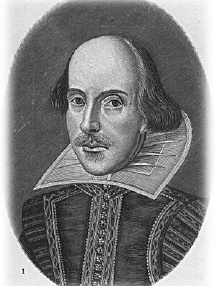
Shakespeare: unanswered questions
Nearly 450 years after his birth, William Shakespeare is still generally considered to be the greatest writer in the English language. Yet
Shakespeare is generally believed to have been born on the 23rd April 1564 in Stratford-upon-Avon in Warwickshire, England, the son of a glove maker. He died on the same day in 1616, at the age of 52, in the same town. He was buried in the church where he had been baptised. little is known about the man himself and some critics actually doubt whether he wrote the plays at all.
Very few facts are known of Shakespeare’s early life. He married at 18, but he soon left Stratford and his family to start his acting career. By 1610, Shakespeare had already written most of his 37 plays and his poetry. In this year, 400 years ago, at the age of 46, he retired from London, where he had been living and working for many years.
It is certain that this later period in Shakespeare’s life was quieter. It was a time when his acting company toured much less across the country. Shakespeare was also in a very comfortable financial position and he was officially a ‘gentleman’, much admired by King James and other important figures. He had a very large house in Stratford, as well as being the owner and landlord of other property. In addition, he part-owned two theatres in London, where his plays were regularly performed.
However, this historical figure is still surrounded by mystery: details of Shakespeare’s early life are thin; there is little information about his private life; for a literary genius, his education and also his life experiences seem surprisingly limited. Some critics even question whether the plays are actually his, and have suggested more educated, widely-travelled authors*. Others consider the size of his house and wealth to be evidence that William Shakespeare was in fact a businessman, not a playwright. He certainly had an eye for business and investment, as well as being a remarkable writer. That is, if you believe he wrote the plays!
James Shapiro, a Professor of English, recently published his book Contested Will, the latest in a line of books examining exactly who wrote these famous works. He concludes with certainty that the plays are Shakespeare’s own, although he does highlight the theory that many of the later plays were actually cowritten. This of course is not a popular theory with many lovers of Shakespeare who will prefer not to think of him as a team-player. All things considered, it is unlikely that this book will end the mystery and controversy which surrounds this literary giant.
Adapted from www.macmillanglobal.com May 5th. 22.53 P
Glossary
co-write (verb) – to write with someone else; critic (noun) – someone who does not agree with something and gives their opinion about it; doubt (verb) – to think that something will not happen or that it is untrue; highlight (verb) – to describe something in such a way that makes people notice it; limited (adj) – not very good, or not very great in amount; wealth (noun) – a large amount of money and other valuable things.
What important conclusion does Shapiro reach in his new book about Shakespeare?