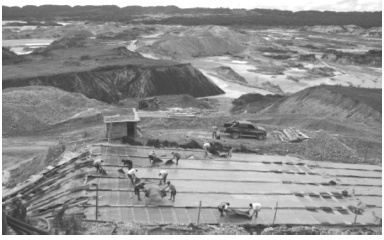
The New Gold Rush
Soaring gold prices are causing a new mining boom
that’s threatening the Amazon rainforest.
As stocks and bonds tumble from the Dow to the DAX, investors are scrambling for fireproof assets—and for many market watchers, the refuge of choice right now is gold. The ancient hedge for troubling economic times has soared since the economic collapse of 2008, spiking 23 percent just since January. By this week the price of an ounce of gold was close to $1,800, a nearly sevenfold increase over 2001.
But in the stampede to safety, fortune hunters are leaving behind a heavy footprint. The story is the same across the developing world: Fueled by market buzz, miners wielding picks, pans, and dredging machines are heading to locations as far-flung as the Australian outback and the Nigerian jungle. On Indonesia’s Paradise Island, hundreds of illegal claims have sprung up in the last three years, digging up the storied mountains behind the famed tourist resorts.
Yet nowhere has the impact been greater than in Latin America, which is blessed—and cursed—by some of the richest veins of mineral ore in the world. The post-crisis gold rush is on fire in some of the remotest stretches of the American tropics, and once again it comes with the snarling of chain saws, infectious disease, and a whiff of cordite. “Every time there’s a significant rise in gold prices, marginal gold mines spring back to life in the remotest regions,” says Marcio Santilli, who works for a Brazilian indigenous-rights group, Instituto Socioambiental. “That often means trouble.”
Ten years ago, with the easy alluvial gold all but gone and ore prices sagging, most wildcat miners had quit the jungle camps for the cities, trying their luck with odd jobs in the urban slums of Boa Vista, Cuzco, Manaus, Porto Velho, and Quito. But with ore prices up nearly 50 percent in value over the last 12 months, gold fever has swept the rainforest again. “What brings gold mining back to life is cheaper fuel and high prices for gold, and that’s exactly what we have right now,” says Luciano Borges, an economist who advises Brazilian mining companies.
In Colombia, Ecuador, Guyana, Brazil, and especially Peru, miners are on the move, scraping away forests, rifling the soil, and turning over streambeds for specks of gold.
Ground zero for the new treasure hunt is the Peruvian Amazon, where some 40,000 miners swarm claims along the Madre de Dios river, which rises in the southern Andes and flows east into Brazil. Though it’s hard to imagine, this army in rags roots up nearly 20 percent of Peru’s annual take of 175 metric tons of gold.
It also leaves a wake of destruction behind it. Riverbanks dissolve as prospectors power-hose the clay, sucking up the detritus into diesel-powered dredges. Globs of toxic mercury, which prospectors use to bind with alluvial gold, fall into streams, where the mercury is taken up by plants and fish— and eventually humans. Though few strike it rich, and those who do often blow their take in a single bender, expectation pulses through the miners’ camps like aguardiente, the cheap cane rum that fuels imaginations and brawls. Prostitutes and thieves troll the Amazon boomtowns, where there’s also a brisk business in guns and drugs.
(August 19, 2011 | www.newsweek.com)
The underlined word “though” could be replaced, without changing its meaning, by: