TEXTO:
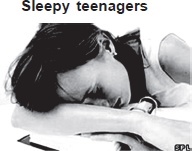
Teenagers are renowned for enjoying lengthy
lie-ins in the morning. But contrary to popular belief,
their reluctance to get out of bed may not be just down
to laziness alone.
[5] This bedroom is a battleground. Morgan’s 17, and
like most other teenagers, she struggles to surface.
Noelle Delaney, her mother, says: “Some days it is very
difficult…you know I have to go in there two, three times.
I have been known to pull her by her feet out of her bed.”
[10] Morgan replies:“It’s too early to get up in the morning,
especially in the winter when it’s quite dark out. It just
seems like you’re getting up in the middle of the night,
you just want to be back in bed.”
And that’s why sleep scientists studied Morgan
[15] and her friends for two weeks. These wrist-mounted
sensors monitored their every move — waking and
sleeping.Analysis of that data surprised the scientists.
They found that consistently the teenagers get just six
and a half hours sleep a night. Most adults need at least
[20] eight. When the clocks moved forward to British Summer
Time the youngsters got even less — just six hours a
night.
As Joanne Bower, from the University of Surrey,
says, “You’ve got something inside you called your
[25] circadian rhythm [body clock] which insures the same
thing happens the same time every day and one of those
things is the secretion of melatonin which is the hormone
that makes you sleepy. Now for an adult you expect
that to be early evening, in teenagers it happens much
[30] later so even if you put your teenager in bed at say ten
at night it may be that they don’t secrete their melatonin
until midnight, one o’clock, so they’re staring at the
ceiling just not sleepy.” Consistent sleep deprivation
can affect concentration, memory or even mood. The
[35] scientists behind this study say more research is needed
because, like Morgan, most teenagers have busy
lives — what they’re not getting is enough rest.
SLEEP teenagers. Disponível em: <www.bbc.co.uk/worldservice/learningenglish/language/wordsinthenews/>. Acesso em: 12 out 2012.
“You’ve got” (l. 24) is the same as you