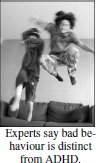
ADHD 'is not bad behaviour'
By Caroline Parkinson Health reporter, BBC News
[1] A child is being disruptive in the classroom -
not paying attention, talking and annoying those
around him. Does he have Attention-deficit hyperactivity
disorder? Or is he
[5] simply badly-behaved?
It is a question many parents
may have asked themselves
about their child or about
someone else's. But experts
[10] say if parents think their child
may have ADHD, they are
probably right. Bad behaviour is
intermittent and often
premeditated, experts say.
[15] Attention-deficit hyperactivity disorder, on the
other hand, affects a child in all aspects of its life.
So a child letting off steam and running around the
house when they come home from school is not a
problem in itself.
[20] But if teachers are also reporting they are failing
to pay attention in the classroom, and they do not
seem to have many friends it may be that they do
need a specialist assessment.
No clue'
[25] Andrea Bilbow, chief executive of the charity
ADDISS, (The National Attention Deficit Disorder In-
formation and Support Service), which helps fami-
lies affected by the condition, says ADHD "is not
about a badly-behaved child". She adds: "It's about
[30] a problem in the brain which means a child can't
regulate their behaviour or emotion. They don't
learn from their mistakes and they can't plan or or-
ganise, and they have difficulties with their short-
term memory.
[35] "The bad-behaviour label is just used by people
who don't have a clue."
Ms Bilbow, who has a child with ADHD herself,
said parents are aware there is something wrong
from an early age. “Even when he was at nursery I
[40] knew. You hope things will improve, even though
you know really that they won't."
Professor Tim Kendall who oversaw the compila-
tion of guidelines on treating ADHD for the National
Institute for health and Clinical Excellence (NICE),
[45] said: "When parents are saying 'this is getting really
difficult and nursery or school is saying the child is
difficult to look after, then it's time to get an assess-
ment."
But the arguments around ADHD aren't solely
[50] focused on the diagnosis. There is also debate
about what causes it. The latest research suggests
it is linked, at least in some cases, to a genetic fault.
Drug debate
But even the researchers behind the study say
[55] their finding will not explain all cases of ADHD, and
that a child's environment also matters.
Peter Hill, an honorary consultant at Great Or-
mond Street Hospital and ADHD expert, said linking
the condition to genetic factors was not new - and
[60] was certainly not the whole answer. "We've known
there was a link for the last 20 years. What this
study has done is shown what kind of genetic ab-
normalities might be involved. "But there are both
genetic and environmental causes, and their envi-
[65] ronmental factors are many."
Professor Kendall agreed genes and environ-
ment both played a part and warned it would be
wrong to focus solely on genetics. He warned" It
does relieve some people because they think 'it's
[70] not my fault - my child was just born like this'. "The
important thing is making sure these kids get really
good treatment. If people think it's just a biological
problem they will only look for biological solutions -
medications."
[75] He said the first option for a child should be to try
and help them manage their behaviour and support
for them in the classroom. Parents can also learn
methods of managing their child's behaviour, such
as introducing strict routines. Only in severe cases
[80] should drugs like Ritalin be used, he added. How-
ever, whether or not to use medication is yet an-
other area that causes argument.
Andrea Antunes, whose son takes daily medica-
tion for his ADHD, said it had changed his life. "He's
[85]doing well at school. He's also making friends and
being invited to parties - which he wasn't before.
"Who am I to deprive him of that?"
30 September 2010 Last updated at 14:39 GMT http://www.bbc.co.uk/news/health-11443945.
A exemplo de “behaviour” (título), os seguintes vocábulos são classificados, morfologicamente, como substantivos formados pelo acréscimo de um sufixo, exceto