By Reuben Fischer-Baum for The Washington Post
1 In the past three decades, the United States has seen staggering technological changes. In 1984,
just 8 percent of households had a personal computer, the World Wide Web was still five years
away, and cell phones were enormous. Americans born that year are only 34 years old.
Here’s how some key parts of our technological lives have shifted, split loosely into early,
[5] middle and current stages.
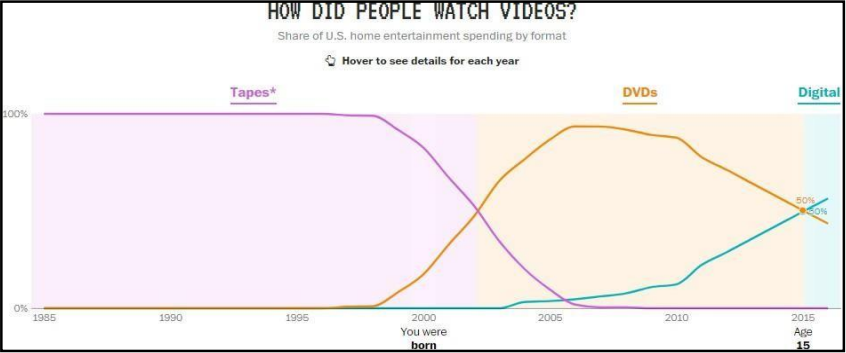
Blockbuster isn’t quite dead yet — as of April there were at least 10 U.S. locations still in operation, mostly in Alaska. But the era of physical videos is on its way out. Children today may never
know the swelling music of a DVD menu that’s looped back to the beginning. And they certainly
will never have to rewind a VHS tape.
[10] But this is just one slice of how home entertainment has changed over the past 30 years. Thanks
to plummeting prices, most Americans now own (large!) HD TVs that were once reserved for the
very wealthy. During the same era, cable overtook network television in profitability and prestige.
Both are now threatened by the twin specters of cord-cutting and streaming.
Twenty years ago the Internet was still mostly for play — Geocities was one of the most popular
[15] sites on the Web.
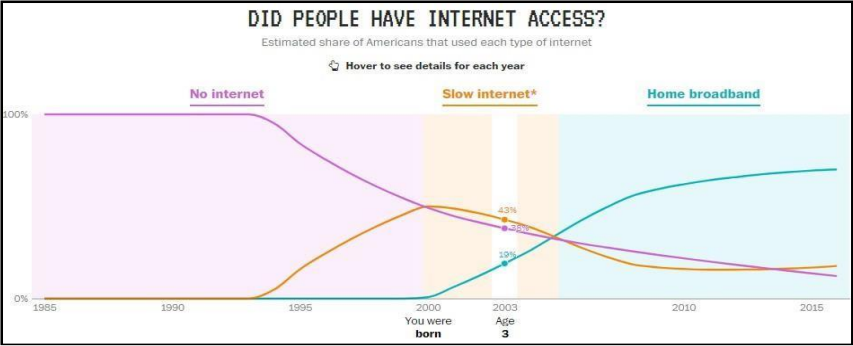
And it was slow! Dial-up — which uses pre-existing telephone lines to connect to the Internet
— was the primary internet technology throughout the ’90s, until faster Broadband services began
to take hold. Dial-up had a max speed of 56 kilobits per second, and could be interrupted by an
incoming phone call
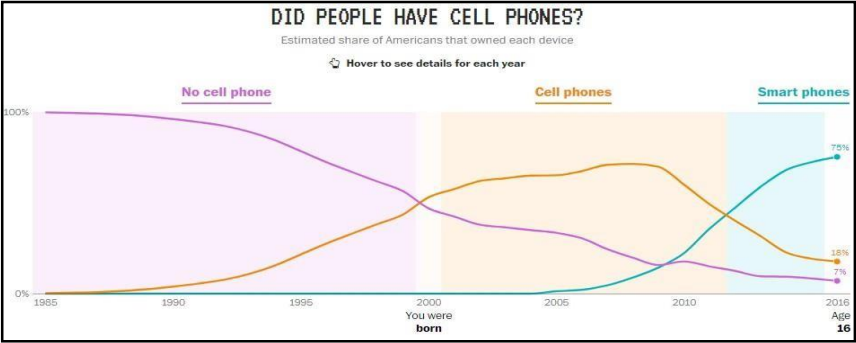
[20] While the first mobile phone call was made in 1973, it took the technology a while to reach the
masses. In the late ’80s, cellphones were still an extravagance, notably used by Gordon Gecko in
1987’s “Wall Street.”
A decade a half later, Nokia and other manufacturers had developed much cheaper models. In
particular, the nearly indestructible Nokia 3310 affectionately known as the “brick” — has a special
[25] place in U.S. mobile history as the first cell phone for many younger Americans.
(Fonte: https://www.washingtonpost.com/adaptado)
O texto é uma adaptação e contempla informações sobre a evolução e o consumo de tecnologias ao longo dos anos, principalmente, na América do Norte.
A alternativa que indica o título mais adequado ao texto é: