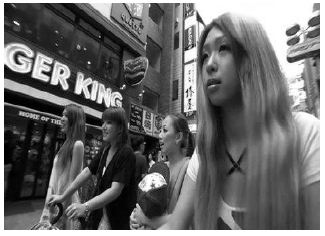
Japan harnesses fashion power of gals
By Mariko
Oi BBC News, Tokyo
29 August 2012 Last updated at 23:52 GMT
In every country, there are sub-cultures who define themselves through fashion. The West has goths, hippies and grunge, for example. Japan has gals.
They are young girls who look, act and speak very differently from the traditional image of Japanese women.
Since they emerged as a group in the mid-90s, their looks have evolved. But a few elements have remained constant - short skirts, massive heels and big, big eyes.
This type of rebellion has been frowned on in the past. But now these gals are being courted - for their spending power, their adventurous mindset and even as a cultural export.
Gals, named for the Japanese pronunciation of girl - gyaru, were the product of the boom years - urban teens with a disposable income who were keen to stand out.
Their fashion went through various stages - big socks, foot-high wedge heels, silver hair, deep bronze skin.
The wildest of all was a group called Yamamba, who wore large circles of unnaturally white eyeshadow, giving a reverse panda-eye effect.
Changing tastes
Gals\\' spending power has been in the spotlight before. Their desire to keep up with the latest fad meant that they spent a lot of money on clothes and shoes. "Their fashions changed very fast, and gals followed each trend religiously," said Nobuko Yabe of gals\\' magazine Popteen.
Their favourite shopping centre, Shibuya\\'s 109 store, saw its sales double between 1995 and 2008, as other department stores struggled with falling sales.
But gals could not shield 109 from the impact of the global financial crisis. As hard times hit, they started to shop at slightly cheaper global brands, such as H&M and Zara. And the economic crunch has curtailed their fashion ambitions to an extent.
"We are seeing a slowdown in gals\\' evolution and today we see fewer obvious gals," says Ms Yabe. But they remain an important sub-culture - and one that Japan\\'s government wants to exploit.
The cabinet has approved plans to recreate fashionable districts of Tokyo in foreign cities and it hopes to export four trillion yen ($51bn; £32bn) worth of "Cool Japan" fashion by 2020. So the one-time rebels have found their place in society.
"These gal-mama may look rebellious," said Ms Yamashita of I Love Mama magazine. "But the advice that they gave me when I became a mother myself really showed that they contribute to society no matter how they dress."
(http://www.bbc.co.uk/news/world-asia-19332694)
No que se refere a hábitos de consumo, de acordo com o texto,