Leia o texto para responder à questão.
Black authors shake up Brazil's literary scene
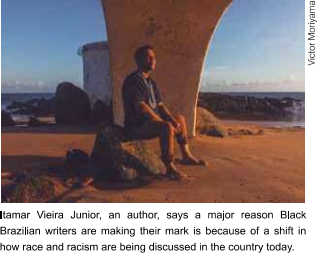
Itamar Vieira Junior, whose day job working for the
Brazilian government on land reform took him deep into the
impoverished countryside, knew next to nothing about the
mainstream publishing industry when he put the final touches
on a novel he had been writing on and off for decades. On a
whim, in April 2018, he sent the manuscript for Torto Arado,
which means crooked plow, to a literary contest in Portugal,
wondering what the jury would make of the hardscrabble tale
of two sisters in a rural district in northeastern Brazil where the
legacy of slavery remains palpable.
To his astonishment, Torto Arado won the 2018 LeYa
award, a major Portuguese-language literary prize focused
on discovering new voices. The recognition jump-started
Mr. Vieira's career, making him a leading voice among the
Black authors who have jolted Brazil's literary establishment
in recent years with imaginative and searing works that have
found commercial success and critical acclaim.
Torto Arado was the best-selling book in Brazil in 2021,
with more than 300,000 copies sold to date. The previous
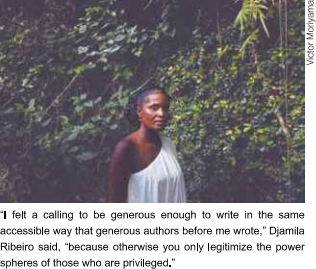
year, that distinction went to Djamila Ribeiro's A Little
Anti-Racist Handbook (Pequeno Manual Antirracista), a
succinct and plainly written dissection of systemic racism
in Brazil.
Mr. Vieira, a geographer, and Ms. Ribeiro, who studied
philosophy, are part of a generation of Black Brazilians who
became the first in their families to get a college degree,
taking advantage of Federal Government programs. Mr. Vieira
managed to use his day job at Brazil's land reform agency,
where he has worked since 2006, to do field research. He
studied the politics and power dynamics that shape the
lives of rural workers, including some who toil in conditions
analogous to modern-day slavery. That experience, he said,
made the characters in his novel more layered and their
fictional hometown, Água Negra, which means black water,
feel authentic.
The two authors are among the highest profile figures
of a literary boom that includes Black contemporary writers
and authors who are experiencing a revival. The clearest
example is Carolina Maria de Jesus, who died in 1977 and
whose memoir, Child of the Dark (Quarto de Despejo), is now
a literary sensation, as it was when it was published in 1960.
The book, a compilation of diary entries by Ms. Jesus, a single
mother of three, offers a raw account of daily life in a São
Paulo slum where dwellers picked through garbage for food
and slept in shacks patched together with slabs of cardboard.
(Ernesto Londofio. www.nytimes.com, 12.02.2022. Adaptado.)
No trecho da legenda da imagem que retrata Djamila Ribeiro “because otherwise you only legitimize the power spheres of those who are privileged”, o termo sublinhado expressa