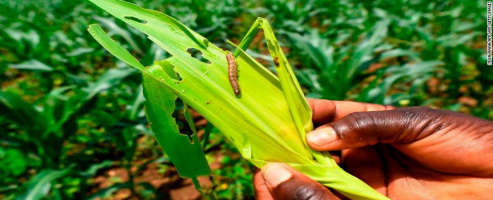
After wreaking havoc in Africa, 'impossible to kill' crop-destroying worm reaches Asia
By Swati Gupta,
CNN August 14, 2018
After leaving a trail of ruined crops in Africa and the Americas, an invasive worm has been found in India, prompting concern that it could
have a devastating effect on the country's agriculture.
Fall armyworm, a pest which feeds on maize and other key crops, has been detected in the state of Karnataka, according to officials. In
neighboring Tamil Nadu, about 15% to 20% of the maize crops on the campus of Tamil Nadu Agricultural University showed evidence of
[05] the worm.
It has already ravaged a dozen or so countries in Africa, with some areas of Zimbabwe suffering up to 70% crop destruction. According
to the Center for Agriculture and Bioscience International (CABI) and the UK's Department for International Development, African nations
stand to lose between 2.4billionand6.1 billion due to the worm.
Indian officials and observers are fearing a similar effect on the subcontinent. "This will certainly spread to India's neighbors to the east,"
[10] said Roger Day, program executive of Action on Invasives at CABI. He said that East and Southeast Asia has plenty of "environmentally
suitable" areas where the pest can thrive, including Bangladesh, Myanmar, Laos, Thailand, Vietnam, Philippines, Indonesia, and China.
And there's little anyone can do about it. Previous and costly attempts to stop the worm have been largely unsuccessful. With the worm
detected in at least two states so far, SK Jalali, a scientist at the Indian Council of Agricultural Research (ICAR), said he and his colleagues
are bracing themselves for the worst. "How the worm will spread, we do not know yet," Jalali said. Labs across India have been alerted
[15] and told to do surveys of their own, but it may be too late to stop the worm's expansion.
"It looks like that it has already been present for a while. I would not be surprised if it has already spread past Karnataka," said Day. The
Indian infestation is being monitored by multiple international organizations, including CABI and the United Nations' Food and Agricultural
Organization.
The goal, Day said, should be control rather than eradication. Scientists and researchers have formulated ways to slow the spread or to
[20] fight the infestation using bio-pesticides. However, Jalali warned that with the infestation still in its early stages, "we don't know what will
work on it." Due to the speed at which the pest multiplies, India will have to move faster in evaluating the impact and helping farmers.
(Retrieved and adapted from: https://edition.cnn.com/2018/08/14/asia/india-armyworm-crop-infestation-intl/index.html?utmcontent=2018−08−15T11%3A30%3A08&utmsource=fbCNNi&utmterm= link&utmmedium=social. Access on August 18th, 2018.)
The main goal of the text is