TEXT A
The Final Upgrade
Every new computer comes with one guarantee: There will be a faster, shinier, newer model in short order – and you will fawn over it. It’s hard not to. Processors double in power every 18 months, and other parts turn over even more quickly. Memory gets faster. Screens pack more pixels. Hard drives grow larger. And so on. Like it or not, the product cycle is also a cycle of dependency. We don’t just want the newest thing – we actually need it in order to run the latest programs. But there is a way out (…)
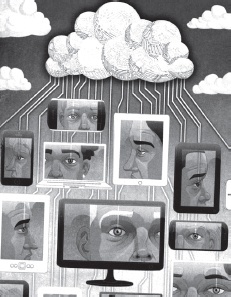
In the last decade, the cloud has started to change how people use their PCs. Connectivity is now just as important as hardware, which gives users ready access to software and backup services over the Internet. (…) In 2011 Google introduced Chromebooks, the first laptops that rely almost entirely on the cloud to deliver software to users. As a result, the machines need only a bit of memory and a low-power processor. (…)
Neverware, a New York start-up, has developed software that can deliver complete instances of Windows to up to 100 computers over Ethernet or Wi-fi. (…) And as broadband access improves, Neverware hopes to deliver the entire service through the cloud. Intel Labs’s Clone Cloud project (…) could do for old smartphones what Neverware does for old computers. (…) Every videogame, every website, every piece of software will work everywhere. And hardware will never be out-of-date again.
Popular Science, October 2013.
In the last decade, the cloud has started to change how people use their PCs. Connectivity is now just as important as hardware, which gives users ready access to software and backup services over the Internet. (…) In 2011 Google introduced Chromebooks, the first laptops that rely almost entirely on the cloud to deliver software to users. As a result, the machines need only a bit of memory and a low-power processor. (…)
Neverware, a New York start-up, has developed software that can deliver complete instances of Windows to up to 100 computers over Ethernet or Wi-fi. (…) And as broadband access improves, Neverware hopes to deliver the entire service through the cloud. Intel Labs’s Clone Cloud project (…) could do for old smartphones what Neverware does for old computers. (…) Every videogame, every website, every piece of software will work everywhere. And hardware will never be out-of-date again.
Popular Science, October 2013.
Neverware, a New York start-up, has developed software that can deliver complete instances of Windows to up to 100 computers over Ethernet or Wi-fi. (…) And as broadband access improves, Neverware hopes to deliver the entire service through the cloud. Intel Labs’s Clone Cloud project (…) could do for old smartphones what Neverware does for old computers. (…) Every videogame, every website, every piece of software will work everywhere. And hardware will never be out-of-date again.
Popular Science, October 2013.
According to TEXT A, the cloud