Fuvest 2026 · Questão 81/79
During the nineteen-seventies and eighties, a researcher at the University of Washington started noticing something strange in the college's experimental forest. For years, a blight of caterpillars had been munching the trees to death. Then, suddenly, the caterpillars themselves started dying off. The forest was able to recover. But what had happened to the caterpillars? The researcher, David Rhoades, who had a background in chemistry and zoology, found that the trees in the forest had changed the chemistry of their leaves, to the detriment of the caterpillars. Even more surprising, trees that had been nibbled by caterpillars weren't the only ones that had changed their chemistry. Some were changing their leaves before caterpillars reached them, as if they'd received a warning. A shocking possibility presented itself: the trees were signalling to one another. Zoë Schlanger recounts Rhoades's story in her new book, "The Light Eaters: How the Unseen World of Plant Intelligence Offers a New Understanding of Life on Earth." The contemporary world of botany that Schlanger explores in "The Light Eaters" is still divided over the matter of how plants sense the world and whether they can be said to communicate. But, in the past twenty years, the idea that plants communicate has gained broader acceptance. Research in recent decades has shown garden-variety lima beans protecting themselves by synthesizing and releasing chemicals to summon the predators of the insects that eat them; lab-grown pea shoots navigating mazes and responding to the sound of running water; and a chameleonic vine in the jungles of Chile mimicking the shape and color of nearby plants by a mechanism that's not yet understood. Schlanger acknowledges that some of the research yields as many questions as answers. It's not clear how the vine gathers information about surrounding plants to perform its mimicry. New Yorker. 12 June 2024. Adaptado.
O processo de comunicação entre plantas discutido no texto pode ocorrer de diversas formas. Uma delas baseia-se na emissão de moléculas por uma planta atacada, chamada de emissor, e a recepção dessas moléculas por uma outra planta, chamada de receptor. Dependendo do tipo de ataque e das espécies envolvidas, essa comunicação pode acontecer tanto por via aérea, quanto por via do solo, facilitada pela água presente.
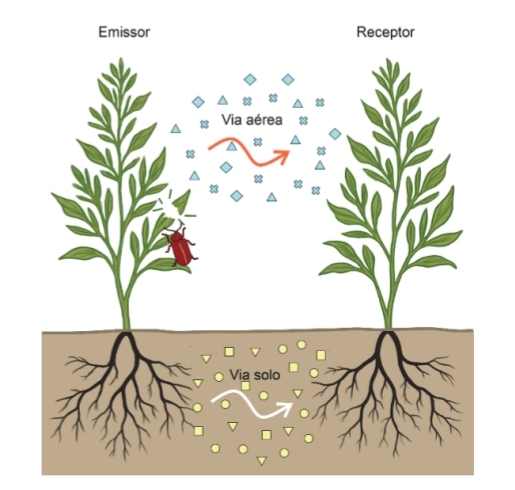
Considerando os processos de sinalização entre plantas descritos, é correto afirmar:
Resolução passo a passo com explicação detalhada
Química > Forças Intermoleculares > Polaridade e Afinidade Química
Polaridade e Afinidade Química aparece em ~1% das questões de Química (93 questões no banco).
EsPCEx 2024
Questão 37
Os lenços umedecidos são um produto criado na década de 1950 nos EUA e que, de c
AM ENEM 2024
Questão 124
Em um experimento de física, foi observado um fenômeno interessante envolvendo a
UVV 2022
Questão 28
A regra - substância polar tende a se dissolver em outra substância polar - pode
Vestibulinho ETEC 2022
Questão 41
Uma excelente medida de higienização é lavar as mãos com água e sabão. O segredo
