Coronavirus: What is 'flattening the curve’?
In epidemiology, the idea of slowing a virus' spread is known as "flattening the curve." Many countries are implementing "social distancing" guidelines to flatten the curve.
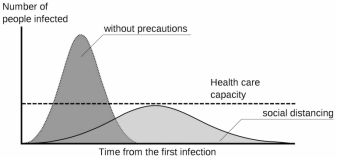
The "curve" researchers are talking about refers to the projected number of people who will contract Covid-19 over a period of time. Here's what one looks like:
The curve takes on different shapes, depending on the virus's infection rate. It could be a steep curve, in which the virus spreads exponentially, and the total number of cases skyrockets to its peak within a few weeks. Infection curves with a steep rise also have a steep fall; after the virus infects everyone who can be infected, case numbers begin to drop exponentially, too.
The faster the infection curve rises, the quicker the local health care system gets overloaded beyond its capacity to treat people. More and more new patients may be forced to go without Intensive Care Unit beds, and more and more hospitals may run out of the basic supplies they need to respond to the outbreak.
A flatter curve, on the other hand, assumes the same number of people ultimately get infected, but over a longer period of time. A slower infection rate means a less stressed health care system, fewer hospital visits and fewer sick people.
Source:By Brandon Specktor - Senior Writer March 16, 2020 https://www.livescience.com/coronavirus-flatten-thecurve.html (Adapted).
According to the text