TEXTO:
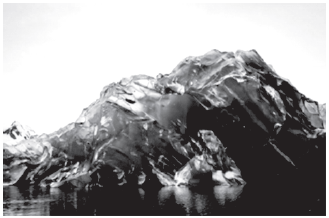
While on vacation with his family, designer and
filmmaker Alex Cornell captured the exquisite beauty of
the underbelly of an iceberg. Last month, Cornell traveled
with his mother and sister on a National Geographic
[5] expedition in Antarctica. “A landscape peppered with
icebergs is a special one indeed,” he wrote to The
Washington Post. “I think the most overwhelming thing
about them is their scale. … The thought of ice towering
over you is pretty remarkable.” As impressive as icebergs
[10] are, many of them look the same. But when
Cornell reached Ciera Cove, he saw something
different — an iceberg of a deep, blue color: “I didn’t know
what I was looking at — after all, I was still acclimating
to the typical icebergs. The naturalist on-board was
[15] thankfully very quick to explain to us how lucky we were
to spot such an unusual looking specimen. His
excitement quickly translated to the rest of us.”
He explained that glacial ice becomes blue when it
becomes very dense: “Years of compression gradually
[20] make the ice denser over time, forcing out the tiny air
pockets between crystals. When glacier ice becomes
extremely dense, the ice absorbs a small amount of red
light, leaving a bluish tint in the reflected light, which is
what we see. When glacier ice is white, that usually
[25] means that there are many tiny air bubbles still in the
ice.” Cornell believes the iceberg flipped over recently due
to the lack of snow on top of it. It’s not a rare occurrence,
but it is indeed a beautiful one. “I took a substantial amount
of photos as we made our way around, and I’m glad I
[30] did,” he said.
KIRKPATRICK, Nick . Disponível em: http://www.washingpost.com/news/ morning-mix/wp/2015/01/20/themajestic-beauty-of-the-underbelly-of-aniceberg/!utm-term=82e848fc15e1. Acesso em: 12 out. 2017. Adaptado.
Alex Cornell found the Antarctica landscape